
Emotional Dysregulation in Children: Is It Defiance or an Overwhelmed Nervous System?

Defiance or Dysregulation: what behavior may be telling us about the nervous system
When a child refuses to get dressed, screams because the wrong cup was placed on the table, runs away when it is time to leave, or completely shuts down over a simple request, it can look like defiance. But emotional dysregulation in children is not always a matter of choosing not to cooperate. Sometimes the child's nervous system is struggling to regulate sensory information, stress, movement, and automatic protective responses well enough to access the higher-level skills we are asking them to use.
Understanding that difference changes the question from, "How do I make this behavior stop?" to, "What is making it so difficult for this nervous system to respond differently?" That does not mean every challenging behavior is dysregulation or that children should not have boundaries. It means we need to understand the foundation supporting behavior before deciding how best to change it.
What Is Emotional Dysregulation in Children?
Emotional regulation is much more than controlling emotions. It depends upon the nervous system's ability to receive information from inside and outside the body, determine what requires attention, adjust its level of arousal, and organize an appropriate response. When that system works efficiently, a child can experience frustration, disappointment, sensory input, unexpected changes, and everyday demands without repeatedly being pushed into an excessive stress response.
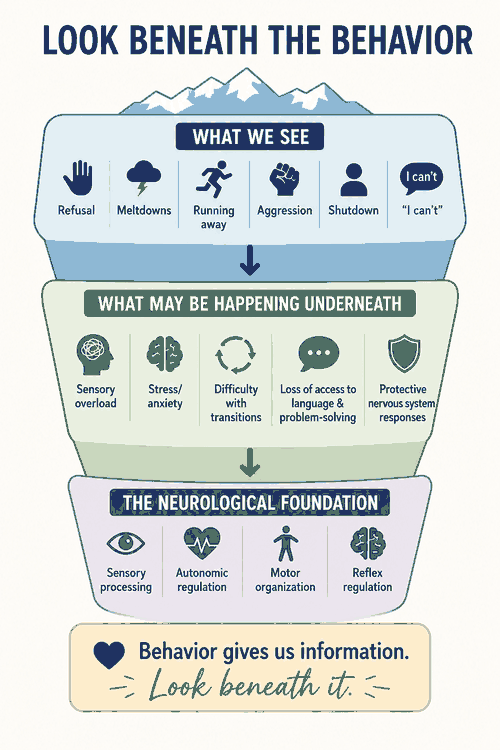
When the nervous system has difficulty regulating that information, relatively ordinary experiences can require significantly more neurological effort. The child may move quickly into freeze, fight, flight, avoidance, or shutdown responses, while access to language, impulse control, flexible thinking, motor planning, and problem-solving becomes less efficient. What adults see as "behavior" may actually be the visible end result of a nervous system struggling to organize itself.
This is one reason I look beyond emotional regulation itself when evaluating a child. Sensory processing, motor organization, visual and auditory processing, autonomic regulation, and reflex development all contribute to how efficiently the brain and body respond to everyday demands. If those foundational systems require too much effort, expecting the child to simply "use their coping skills" may be asking the highest levels of the brain to compensate for difficulties occurring much further down in the nervous system.
How Protective Reflexes Can Affect Nervous System Regulation
Reflexes are genetically encoded sensory-motor patterns that begin developing before birth and provide some of the nervous system's earliest ways of responding to sensory information, movement, and potential threat. As development progresses, these reflex circuits should mature and become increasingly well regulated, allowing the brain and body to respond efficiently without requiring conscious thought. When protective reflex patterns are hyperreactive, hyporeactive, or poorly organized, however, the nervous system may have difficulty determining when protection is necessary, how strongly to respond, and when it is safe to return to a more regulated state.
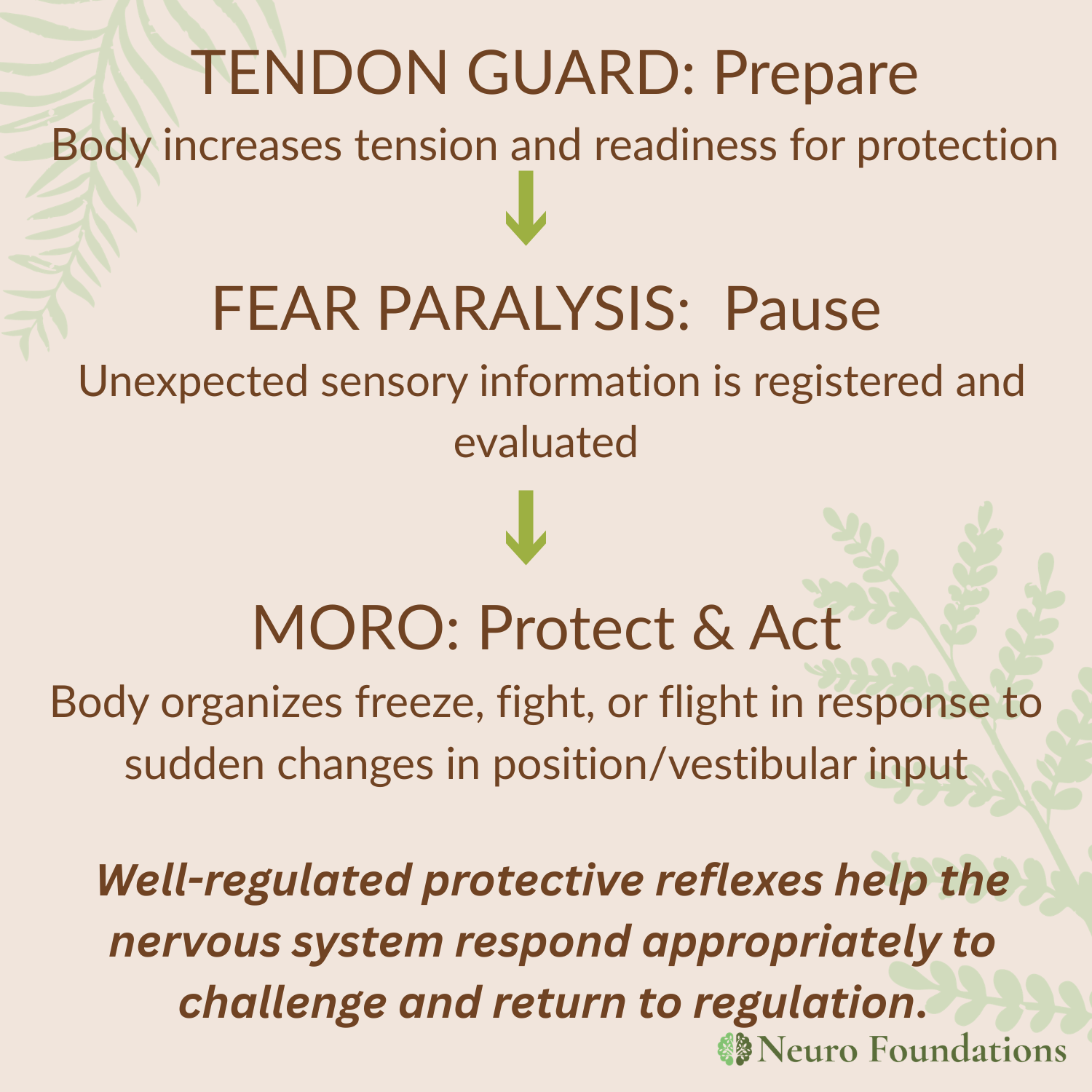
When I evaluate a child who struggles with emotional regulation, three protective reflex patterns I pay particular attention to are Tendon Guard, Fear Paralysis, and Moro. Each contributes something different to the body's protective response, and looking at them together can help us better understand why some children seem to move into anxiety, guarding, freezing, fight, or flight much more readily than others. Reflexes are not the only reason a child becomes dysregulated, but they are an important part of the neurological foundation that can easily be missed when we focus only on the resulting behavior.
Tendon Guard Reflex: Preparing the Body for Protection
The Tendon Guard Reflex helps prepare the muscular and tendinous connections throughout the body to increase tension when protection may be needed. This increased readiness supports the body's ability to freeze, fight, or flee when faced with danger. When the Tendon Guard pattern is not well regulated, the body may maintain more protective tension than the situation actually requires.
Functionally, this can contribute to a child who seems physically tense, guarded, hesitant with movement, or resistant when something feels uncertain. It is also frequently associated with increased anxiety within the nervous system because a body that is continually preparing to protect itself is sending very different information to the brain than a body that feels secure and adaptable. For some children, what looks like emotional rigidity may therefore exist alongside very real physical guarding.
This is one reason regulation cannot be understood only as an emotional or cognitive skill. The brain is continually receiving information from the body, including information about muscle tension, movement, balance, breathing, and internal state. If the body is repeatedly preparing for protection, maintaining emotional regulation may require substantially more effort.
Fear Paralysis Reflex: Creating the Pause Before the Response
The Fear Paralysis Reflex provides something particularly important to regulation: a pause. When unexpected sensory information occurs, such as a sudden sound, something entering peripheral vision, unexpected touch, or a bump from another person, the nervous system needs a brief opportunity to determine whether that information represents danger. That pause creates time for either protective action to begin or for higher cognitive structures to determine, "This was unexpected, but I am safe."
When the Fear Paralysis response is hyporeactive, that pause may be insufficient. Instead of registering the unexpected information, assessing it, and then organizing an appropriate response, the nervous system may move much more quickly into a larger protective response. In everyday life, this can look like a child who reacts before thinking, becomes angry almost instantly, pushes when unexpectedly touched, bolts from a situation, or seems to move from calm to overwhelmed with very little space in between.
This helps explain why telling a child to "stop and think" is not always enough. We are asking for a cognitive pause that the nervous system itself may not be creating efficiently. Developing a better-regulated Fear Paralysis response can be one component of building the neurological foundation for that pause, giving higher-level thinking a better opportunity to participate before the body reacts.
Moro Reflex: Organizing the Body for Freeze, Fight, or Flight
Within the Masgutova Neurosensorimotor Reflex Integration (MNRI) framework, the Moro Reflex is primarily activated by sudden changes in body position and the resulting vestibular input rather than simply by unexpected sounds or sights. Its movement pattern provides an important neurological foundation for the body's freeze, fight, or flight response. The initial flexion brings the core inward toward protection, while the following extension brings the body outward and upright, preparing it to take action.
When the Moro pattern is hyperreactive or poorly regulated, changes in movement, balance, body position, or vestibular information can contribute to a disproportionately strong protective response. A child may become uncomfortable with unexpected movement, react strongly when physically destabilized, or have difficulty maintaining regulation when movement and other environmental demands accumulate. Because the Moro response is closely connected with the body's broader stress response, repeated activation can also make it harder for the nervous system to return efficiently to a calm, organized state.
Looking at these three protective reflexes together can be particularly helpful. Tendon Guard helps prepare the body for protection. Fear Paralysis contributes the pause needed to evaluate unexpected sensory information. Moro helps organize the body's protective freeze, fight, or flight response when action is needed. When these systems are not working efficiently together, a child's reactions may be faster, larger, or harder to recover from than the situation appears to warrant.
What Are the Signs of Emotional Dysregulation in Children?
Emotional dysregulation does not always look like a dramatic meltdown. Some children become louder, faster, aggressive, or impulsive, while others become rigid, avoidant, quiet, or unable to initiate action. Recognizing these different patterns helps us move away from simply asking, "How do I stop this behavior?" and begin asking what the nervous system may be communicating.
Big Emotional Reactions to Small Problems
A child may scream and throw game pieces after losing, sob because a preferred cup is unavailable, or become furious because a sibling sits in "their" seat. These reactions can look manipulative or intentionally dramatic, particularly when the triggering event seems insignificant to everyone else. But the immediate problem may simply be the final demand placed upon a nervous system that has already spent the day managing sensory input, transitions, motor demands, social expectations, and stress.
When reactions consistently seem larger than the situation, look at what happened before the explosion. Did the child just come home from school, spend an hour in a noisy environment, or work hard to manage social and academic expectations all day? The answer often gives us more useful information about emotional dysregulation than the final meltdown itself.
Difficulty With Transitions
A child may melt down every morning when it is time to leave for school, run away when recess ends, or become angry when asked to turn off a preferred activity. Even transitions toward something enjoyable can be difficult because transitions require the nervous system to stop one plan, shift attention, process new information, organize the body, and initiate something different. That is a surprisingly complex neurological task.
Transitions also contain uncertainty, which can place additional demands on a nervous system that already responds strongly to unexpected information. Providing predictability, preparation, visual information, and enough processing time can reduce the neurological demand of the transition. What appears to be refusal may sometimes be a child's attempt to maintain control when changing course feels neurologically overwhelming.
Fight Responses: Yelling, Hitting, or Aggression
A child may yell "No!" when asked to complete homework, push a parent who attempts to help with dressing, or hit a sibling who unexpectedly touches their belongings. These are behaviors that require clear safety boundaries, and dysregulation does not mean aggression should simply be permitted. What changes is our understanding of when the child is neurologically available to learn a better response.
When protective reflexes and the broader nervous system are highly activated, muscle tension, breathing, sensory awareness, and motor responses can all change. The immediate priority is safety and helping the nervous system regain organization. Teaching, accountability, repair, and practicing a different response are still important, but they are much more effective when the child has regained enough regulation to access reasoning and self-control.
Flight and Avoidance Responses
Some children escape rather than fight. A child may run down the hallway instead of entering a noisy classroom, hide under the table when homework appears, or repeatedly leave an activity requiring difficult motor planning or sustained attention. Calling these behaviors "avoidance" describes what the child is doing, but it does not tell us why.
Look for patterns. If escape repeatedly occurs with noise, crowds, unfamiliar movement, challenging academic work, unexpected changes, or situations in which the child does not feel secure, the behavior may be telling us something important about nervous system capacity. Understanding the trigger gives us an opportunity to strengthen the underlying foundation rather than simply increasing the demand.
Freezing or Shutting Down
Dysregulation can also look surprisingly calm. A child may stare blankly when asked a question, suddenly answer "I don't know" to information they clearly know, or sit motionless while everyone else gets ready to leave. These children are sometimes overlooked because their nervous system responds by reducing action rather than increasing it.
A freeze or shutdown response may particularly warrant looking at the child's broader protective responses, including the Fear Paralysis pattern. The child may have difficulty accessing language, initiating movement, making decisions, or processing additional directions in that moment. Repeating instructions louder or adding consequences can increase the demand without increasing the child's capacity to respond.
Loss of Language and Problem-Solving
A child who normally speaks in full sentences may suddenly communicate through "No!", "Stop!", or "I can't!" Another child who can easily identify several solutions when calm may insist during dysregulation that there is absolutely no way to solve the problem. The child has not suddenly forgotten everything they know; access to those higher-level abilities has changed.
This is one of the most useful distinctions between skill and capacity. A child may possess the skill of emotional regulation, flexible thinking, or problem-solving but be unable to consistently access it under stress. Building regulation therefore means improving both the higher-level skill and the nervous system foundation that allows the child to use it when life becomes difficult.
Increased Sensory Sensitivity
A child may suddenly cover their ears in a restaurant they usually tolerate, become extremely irritated by clothing before school, or yell at siblings because ordinary conversation feels unbearably loud. Sensory processing and emotional regulation are closely interconnected because the nervous system is constantly deciding which information requires a response and which information can safely remain in the background. As regulation decreases, ordinary sensory information can require far more attention.
This is another place where reflex regulation may matter. Sound, touch, visual information, movement, balance, and unexpected changes in body position interact with sensory processing and protective reflex systems in different ways. When several foundational systems are inefficient, the child's nervous system may reach overload far more quickly than the environment alone would suggest.
Increased Movement, Impulsivity, or "Wild" Behavior
Some children move more as they become dysregulated. They may crash into furniture before bedtime, run around the classroom when demands increase, or become silly, loud, and unable to stop touching people during a busy gathering. Adults may understandably interpret this as a loss of behavioral control, but movement can also be an attempt by the nervous system to organize itself.
The important question is not simply whether the child moves too much, but what that movement is accomplishing. Does pushing, pulling, jumping, rocking, or rhythmic movement help the child become more organized, or does certain movement increase arousal further? Observing those patterns can provide valuable information about sensory processing, reflex function, body awareness, and the child's individual regulation needs
Is My Child Defiant or Dysregulated?
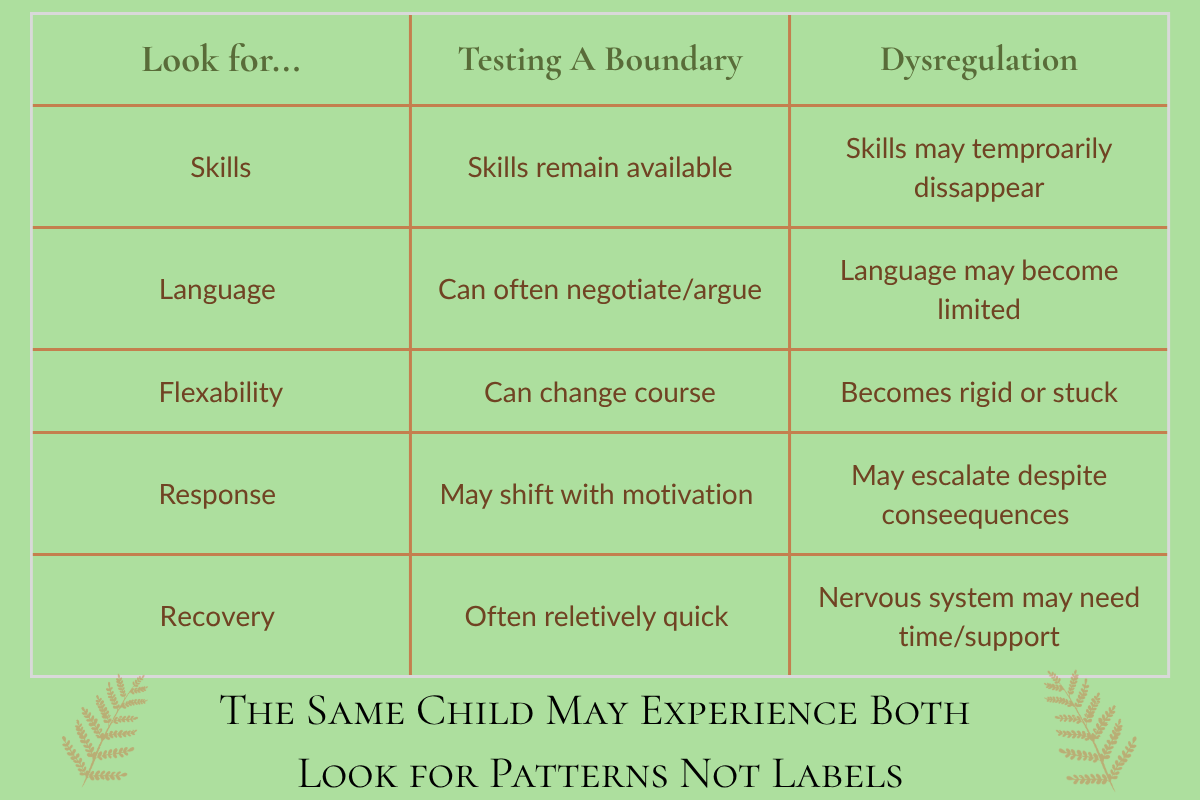
There is no single behavior that automatically means defiance or dysregulation. A child may refuse to put on their shoes because they want five more minutes to play one morning and refuse the next morning because they are overwhelmed, rushing, and unable to organize themselves for another difficult transition. The observable behavior is identical, but what is happening within the nervous system may be very different.
Look at whether the child can demonstrate the expected skill under other circumstances, whether language or motor abilities change during the behavior, and whether difficulties predictably occur around fatigue, sensory demands, transitions, stress, unexpected changes, movement, or challenging tasks. Also pay attention to the speed of the response. Does there seem to be enough pause for the child to process what happened and make a choice, or does the reaction seem to occur almost before the child has registered what is happening?
Dysregulated behavior often does not work particularly well for the child. They may lose something they wanted, miss an activity, damage a relationship, frighten themselves with the intensity of their reaction, or later express genuine remorse or confusion about what happened. Repeatedly losing control despite significant negative consequences is one reason to look beyond compliance and consider what may be interfering with the child's ability to regulate
What About ODD and Pathological Demand Avoidance (PDA)?
Parents searching for answers about frequent refusal, arguing, controlling behavior, or extreme reactions to everyday expectations may encounter terms such as Oppositional Defiant Disorder (ODD) and Pathological Demand Avoidance (PDA). These concepts should not simply be used interchangeably with emotional dysregulation. However, there can be considerable overlap in the behaviors a parent observes, which is why understanding what is happening beneath the behavior is so important.
Oppositional Defiant Disorder (ODD) is a recognized diagnosis characterized by an ongoing pattern of angry or irritable mood, argumentative or defiant behavior, and/or vindictiveness that is more persistent and impairing than developmentally typical limit-testing. A child with ODD may also experience emotional dysregulation, but dysregulation alone does not mean a child has ODD. Likewise, identifying nervous system or reflex difficulties does not rule out ODD; a thorough assessment needs to consider behavior, development, environment, relationships, regulation, and the circumstances in which difficulties occur.
Pathological Demand Avoidance (PDA) is a term commonly used to describe a proposed profile, particularly within autism, in which everyday demands can trigger intense avoidance, distress, or a strong need to maintain autonomy or control. PDA is not currently a standalone diagnosis in the DSM-5-TR, and how it should be defined and understood continues to be debated. For families who recognize this pattern in their child, however, the important functional question remains: What happens within this child's nervous system when a demand is perceived?
A child experiencing significant demand avoidance may negotiate, distract, withdraw, run away, become silly, attempt to control the interaction, or move into a much larger freeze, fight, or flight response as pressure increases. Simply increasing rewards, consequences, repetition, or adult authority may escalate some children rather than improving their ability to respond. Whether a child has an ODD diagnosis, fits a PDA profile, has neither, or is still being evaluated, understanding nervous system regulation adds important information about what happens when expectations exceed the child's available capacity.
A Diagnosis Describes a Pattern, but We Still Need to Understand the Child
Labels can be useful when they help families and professionals recognize patterns and access appropriate support. They become less useful when the label itself becomes the explanation: "He refuses because he has ODD," or "She can't do it because she has PDA." We still need to ask what happens inside this particular child when a demand is placed, something unexpected occurs, or their sense of safety and control changes.
This is where a nervous-system perspective can add another layer to the conversation. Sensory processing, autonomic regulation, reflex function, motor organization, communication, previous experiences, relationships, anxiety, and environmental demands can all influence how a child responds. Assessing those foundations does not replace behavioral, developmental, psychological, or medical evaluation; it helps us develop a more complete picture of why regulation may be difficult.
How Do You Help a Dysregulated Child? Start With the Nervous System
Helping a dysregulated child does not mean eliminating expectations. Children need predictable boundaries, opportunities to develop frustration tolerance, and guidance in learning more effective ways to communicate and solve problems. Regulation gives them greater capacity to use those skills; it does not remove the need to learn them.
In the moment, support may involve reducing unnecessary language, providing calm co-regulation, modifying overwhelming sensory input, slowing a transition, or using movement and sensory strategies known to help that particular child organize. Once the nervous system is more regulated, the child is better able to reflect on what happened, repair relationships, problem-solve, and practice a different response. We are still teaching behavior, but we are teaching it when the brain is available to learn.
For children who repeatedly become dysregulated despite appropriate supports, it may be helpful to look more deeply at the neurological foundation. An occupational therapy evaluation can examine sensory processing, motor organization, postural control, reflex patterns, visual and auditory demands, and how these systems interact when the child is challenged. This broader picture can help identify why regulation requires so much effort for a particular child.
Where Reflex Integration Fits
Reflex integration work is not about forcing protective reflexes to disappear. We need protective responses. The goal is for those reflex circuits to become better regulated so the nervous system can respond efficiently when protection is actually needed without repeatedly responding as though ordinary experiences require an emergency-level response.
For a child with a poorly regulated Tendon Guard pattern, intervention may support the body's ability to move between protective tension and more adaptable muscle activation. With a hyporeactive Fear Paralysis pattern, the work may support the neurological pause between receiving unexpected sensory information and launching into a larger response. With a poorly regulated Moro pattern, intervention may address how the nervous system organizes its response to changes in body position and vestibular information and how efficiently it moves through and recovers from protective activation.
Reflex regulation is not the entire answer to emotional dysregulation in children, ODD, PDA, anxiety, or challenging behavior, nor should it be presented as a treatment for those diagnoses. It is one piece of understanding the neurological foundation upon which higher-level regulation depends. When we combine that information with sensory processing, motor function, emotional development, relationships, environment, and the child's individual strengths and needs, we can make much more informed decisions about support.
Look Beneath the Behavior
The goal is not to replace the label "defiant" with the label "dysregulated." Children sometimes resist, negotiate, test limits, and make choices adults do not like. The goal is to become more accurate about what we are seeing so that the intervention we choose addresses the reason the behavior is occurring rather than only its appearance.
When we understand emotional dysregulation in children as something involving the whole nervous system, behavior becomes valuable information. We can begin noticing whether the child is guarding before a demand even occurs, whether there is a pause between unexpected input and reaction, what sensory or movement experiences trigger protective responses, and how easily the child can return to regulation afterward. Those patterns help us identify where the nervous system may need greater support.
For a child who repeatedly knows what to do but cannot access those skills when overwhelmed, looking beneath the behavior can open a very different path forward. Strengthening the neurological foundation does not eliminate the need for boundaries, emotional skills, or behavioral expectations; it can help give the child a nervous system that is better prepared to use them. With greater regulation comes greater opportunity for resilience, independence, connection, and participation in everyday life.
Frequently Asked Questions About Emotional Dysregulation in Children
What does emotional dysregulation look like in a child?
Emotional dysregulation can include meltdowns, disproportionately large reactions, aggression, running away, avoidance, freezing, shutting down, increased sensory sensitivity, impulsivity, or temporarily losing access to language and problem-solving. One important clue is often a change in the child's capacity: skills they can use when regulated become significantly harder to access under stress. Patterns across situations provide more useful information than any single behavior.
Why does my child overreact to small things?
The "small thing" may not represent the total demand being placed upon the nervous system. A child may already be managing fatigue, sensory input, transitions, motor demands, social expectations, anxiety, or poorly regulated protective responses before the final problem occurs. The spilled drink, changed plan, or sibling conflict may simply push an already taxed nervous system beyond its current capacity.
How can I tell if my child is defiant or dysregulated?
Look beyond whether the child complied and consider what abilities were available during the situation. A child testing a boundary may retain the ability to negotiate, problem-solve, change strategies, and respond when motivation changes, while a significantly dysregulated child may temporarily lose flexibility, language, motor organization, or emotional control. Because both can occur in the same child, patterns over time are more informative than trying to label an individual difficult moment.
Can reflexes affect emotional regulation?
Protective reflexes are one part of the larger neurological system involved in responding to sensory information, movement, stress, and potential threat. When reflex patterns such as Tendon Guard, Fear Paralysis, or Moro are not efficiently regulated, they may contribute to a nervous system that prepares for protection too readily, lacks an effective pause before reacting, or has difficulty organizing and recovering from a protective response. Reflex function should always be considered within the broader picture of sensory processing, motor development, emotional regulation, environment, relationships, and the individual child's functional abilities.
How do you help a dysregulated child?
Begin by helping the nervous system regain enough organization for higher-level thinking to become available again. Depending on the child, that may include co-regulation, reducing language and unnecessary demands, changing sensory input, providing more predictable transitions, or using individualized movement and sensory strategies. When emotional dysregulation is frequent or significantly interferes with everyday life, a more comprehensive evaluation can help identify the foundational factors contributing to the child's difficulty.
At Neurofoundations, we are ready to help you identify what foundational factors may be contributing to your child’s behavioral diffculties.