
Reflex Integration Therapy: Understanding Two Approaches to Reflex Development
Reflex Regulation Vs Reflex Inhibition
When parents or professionals hear that a child has a retained reflex, the next question is often: What does that mean, and how do we address it?
In neurodevelopmental work, there are two main theoretical approaches to working with reflexes: reflex maturation/regulation and reflex inhibition. While both approaches may use movement-based activities, their underlying goals and perspectives on reflexes are different.

Understanding these differences can help parents and professionals better understand how approaches like the Masgutova Method (MNRI®) work and how it differs from approaches that focus on reflex inhibition when looking for reflex integration therapy.
Primitive Reflexes vs. Primary Reflexes
Primitive reflexes are automatic movement patterns present at birth. They originate primarily in the brainstem and help infants survive and begin interacting with their environment. Examples include reflexes related to feeding, protection, and early movement patterns.
These early reflexes form the foundation for later motor development, posture, and coordination.
In the Masgutova Method, reflexes are often referred to as primary reflexes. This term reflects the idea that these reflex patterns are fundamental neurological building blocks that continue to support movement and regulation throughout life.
Rather than disappearing, these reflex circuits typically mature and become integrated into more complex motor systems as the nervous system matures.
When reflex circuits are not well organized, they may appear as:
Hyper-reactive – overly strong or easily triggered, the motor pattern continues past the developmental time frame it is expected to be active.
Hypo-reactive – weak or difficult to activate, the pattern has not been triggered enough to strongly mylenate the pathways of the brain and it is difficult for the body to engage the motor pattern.
Dysfunctional – the motor response provided does not match the sensory stimulus given, often matching a different sensory stimulus.
Any of these patterns can affect coordination, posture, sensory processing, emotional regulation, and learning.
Two Main Theories for Addressing Reflexes

1. Reflex Maturation / Reflex Regulation
(Used in the Masgutova Method)
The reflex maturation perspective focuses on strengthening and regulating the reflex circuit, rather than suppressing it.
The goal is to support the development of the primary motor pattern, so the neural pathway becomes stronger and more efficient. The idea is that reflexes are foundational neurological building blocks that support higher level motor control.
Key Principles
Strengthening the primary motor pattern
The Masgutova Method works to reinforce the original sensory–motor pattern so the nerve network becomes stronger and more efficient. This supports increased myelination of neural pathways. Practitioners work directly with the motor pattern using repetition and controlled strength of force to build that stronger connection.
Working within the phases of reflex maturation
Reflexes develop through five phases of maturation. In MNRI work, practitioners focus on the second phase, when the reflex is no longer in the early chaotic primitive stage and can be worked safely with intentionality.
Training the sensory–motor connection
Reflex circuits include both sensory input and motor response. The Masgutova Method trains the connection between these two elements to help regulate muscle tone, posture, and coordination.
Reflexes are not meant to disappear
In this model, reflexes remain part of the nervous system and continue to support functional movement such as posture, balance, and coordination throughout life.
The Goal
The goal is regulation of the reflex circuit, meaning the individual can:
Activate the pattern when needed
Modify the pattern
Control the strength and timing of the response
Move against the reflex pattern with ease
2. Reflex Inhibition
The reflex inhibition model views primitive reflexes as early developmental patterns that should eventually be replaced by postural reflexes as the brain matures.
If a reflex is still present beyond the age when it should integrate, it is considered retained.
Key Principles
Suppressing the primitive motor response
Intervention focuses on reducing or suppressing the reflex pattern, so it no longer interferes with voluntary movement.
Presence of a reflex pattern is considered “retained”
When an individual demonstrates the motor pattern past the developmental timeframe of the reflex pattern it is considered “retained”. Within this framework there is acknowledgement of reflex patterns that are weak or hypo-reactive. If the pattern is not seen, it is considered integrated.
Developmental Replacement
As development progresses, higher-level postural systems are expected to replace primitive reflex activity. Primitive reflexes are superseded by postural reflexes that support balance, coordination, and voluntary control.
Providing the brain a second opportunity
Programs often use specific physical exercises designed to help the brain inhibit primitive reflexes and strengthen neural pathways that support voluntary control.
The Goal
The aim is for the reflex response to no longer appear during movement, allowing voluntary and postural systems to take over.
Example: ATNR (Asymmetrical Tonic Neck Reflex)

The ATNR, often called the “fencing reflex,” is present in infancy and helps support early auditory processing channels and hand-eye coordination and movement patterns.
When the head turns to one side:
The arm and leg on the face side extend
The arm and leg on the skull side flex
This reflex helps infants begin developing auditory channels and exploring their hands and coordinating vision with movement.
When the ATNR Circuit Is Dysregulated
If this reflex pattern remains overly active, a child may show:
Difficulty crossing midline
Challenges with handwriting
Turning the head while writing causing the arm to straighten
Trouble coordinating both sides of the body
Difficulty tracking across a page while reading
For example, a child may turn their head to look at the board and unintentionally extend their writing arm, disrupting their ability to continue writing.
Learn more about the Tonic Neck Reflexes in relation to vestibular functioning and core strength.
Reflex Regulation (Masgutova Method)
In reflex regulation work, the practitioner works directly with the ATNR sensorimotor pattern.
This may involve:
Gentle stimulation of the reflex pathway using sound, vision or rooting reflex to turn the head
Practicing controlled head turning with organized arm and leg responses
Controlled movement of the flexed limbs while the head is turned toward the extended side.
Gradually introducing movements against the reflex pattern to build control
The goal is for the individual to control and modify the pattern, allowing the head to turn without disrupting arm movement.
The reflex becomes organized and supportive rather than automatic.
Reflex Inhibition
In reflex inhibition approaches, the focus is on reducing the automatic arm response triggered by head turning.
Exercises may include:
Cross-body movements
Crawling or creeping patterns
Activities that stabilize the head while the arms move independently
Working in patterns with the head turned toward the bent and flexed side of the body.
The goal is for head movement to no longer trigger the reflex-driven arm extension.
Reflex Regulation vs. Reflex Inhibition
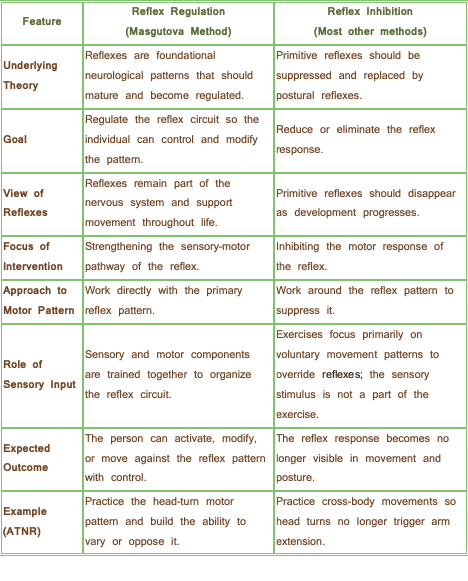
Why Understanding the Difference Matters
Both approaches aim to support neurological development and improve functional movement.
The key difference lies in how reflexes are viewed within the nervous system.
In the Masgutova Method, the focus is on developing and regulating the reflex circuit, so the nervous system has access to a full and flexible movement foundation.
Rather than asking the reflex to disappear, the work supports the nervous system in organizing the reflex so it can serve its intended role in movement, stability, and regulation.
This helps the nervous system organize these foundational patterns so they can support posture, coordination, cognitive development, and self-regulation.
Understanding these two perspectives can help parents and professionals better interpret therapy approaches and the goals behind different reflex-based interventions.
If you’re noticing signs that reflex patterns may be affecting movement, attention, learning, or regulation, you don’t have to figure it out alone. Early identification and the right support can make a meaningful difference in how a child moves, learns, and experiences daily life.
Misti specializes in reflex-based assessment and intervention using the Masgutova Method, helping children, teens, and adults build a stronger neurological foundation for functional skills, emotional regulation, and confidence. Whether you are a parent searching for answers or a professional looking for a deeper understanding of a client’s needs, a personalized consultation can help clarify the next steps.
Reach out today to schedule a conversation or evaluation and learn how reflex regulation may support your child’s development. The right support at the right time can open the door to greater ease in movement, learning, and everyday life.