
Behavior Is a Nervous System Story: Understanding the Foundations of Regulation
Why Behavior Is Often Misunderstood

One of the greatest misunderstandings in child development, mental health, and education is the belief that behavior begins with choice.
When a child melts down over a seemingly minor disappointment, cannot sit still, reacts aggressively, or shuts down completely, adults often assume the behavior is intentional. Similarly, adults struggling with anxiety, overwhelm, emotional reactivity, or chronic exhaustion are frequently told they need better coping skills, stronger willpower, or greater self-discipline.
What if behavior is often the final expression of something happening much deeper within the nervous system?
What we see on the surface—meltdowns, impulsivity, anxiety, withdrawal, sensory sensitivities, or difficulty focusing—is frequently the outward manifestation of a nervous system that is working hard to maintain safety and stability. Before behavior becomes visible, the body has already processed sensory information, evaluated environmental demands, assessed potential threats, activated physiological responses, and organized movement patterns designed to support survival.
Basically, many regulation problems are nervous system problems first.
This perspective shifts the question from "What's wrong with this child?" or "Why can't I get myself together?" to "What is the nervous system communicating?"
As an occupational therapist, I have seen this pattern repeatedly. Children who are labeled defiant are often overwhelmed. Adults who describe themselves as anxious frequently have nervous systems that have remained in protective states for years. Families often arrive exhausted after trying behavior charts, rewards, consequences, and endless reminders, only to discover that the missing piece was not motivation—it was nervous system regulation.
Understanding regulation through a neurodevelopmental lens changes everything because it helps us see behavior as information rather than opposition.
Survival Before Thriving
The nervous system has one primary job: survival.
Long before we can think about learning, social relationships, emotional growth, or academic success, the brain and body must first determine whether we are safe.
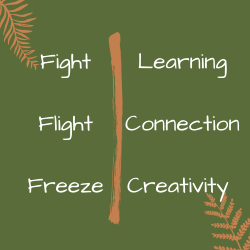
This principle is supported by the work of Dr. Stephen Porges, whose Polyvagal Theory describes how the autonomic nervous system continuously scans both our environment and our bodies for cues of safety and danger. Porges coined the term neuroception to describe this unconscious process. Before we consciously evaluate a situation, our nervous system has already begun deciding whether to engage, mobilize for protection, or shut down.
When we feel safe, the nervous system supports curiosity, connection, creativity, learning, and flexible problem-solving.
When we sense danger, the nervous system reallocates resources toward survival.
This is not a conscious choice. It is biology.
For some individuals, the nervous system can become organized around protection rather than growth. Particularly those who have experienced:
· chronic stress
· trauma
· neurodevelopmental differences,
· medical challenges
· sensory processing difficulties
· developmental disruptions
Survival responses become the default operating system. The result is a nervous system that spends more energy managing threat than supporting thriving.
What the Nervous System Actually Does
Most people think of the nervous system as the brain and spinal cord. In reality, it is an incredibly complex communication network connecting the brain, spinal cord, sensory systems, muscles, organs, hormones, and immune system.
Every second of every day, information flows between the body and brain. Sensory receptors in the skin, muscles, joints, inner ear, eyes, and internal organs send millions of pieces of information upward through the spinal cord. The brain interprets these signals and sends messages back to the body that influence posture, movement, attention, emotions, heart rate, breathing, digestion, and behavior.
This constant exchange is known as body-brain connection.
Modern neuroscience increasingly demonstrates that regulation is not simply a function of thinking. It emerges from the ongoing interaction between the body and brain.
The nervous system is continuously asking: Am I safe enough to learn, connect, and engage?
The answer influences far more than behavior. It affects attention, emotional regulation, executive functioning, social engagement, learning, sleep, digestion, motor coordination, and overall health.
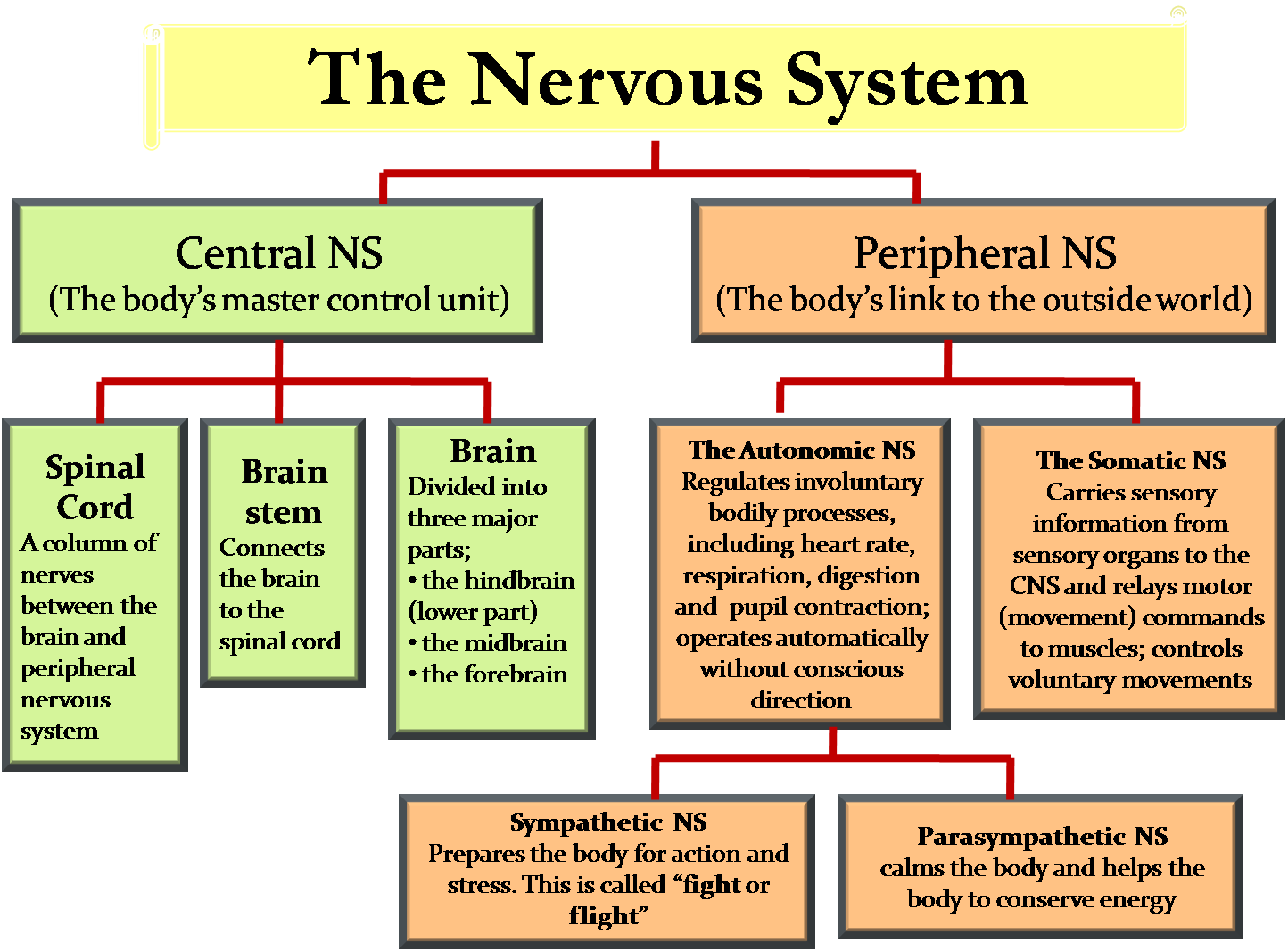
Regulation starts from the bottom up - in the Autonomic Nervous System
The Autonomic Nervous System
At the center of regulation is the autonomic nervous system, which governs functions that occur automatically, including breathing, heart rate, blood pressure, digestion, muscle tone, and stress responses.
A healthy autonomic nervous system is not one that remains calm all the time. Rather, it is one that can move flexibly between activation and recovery based on the demands of the environment.
When a challenge arises, the sympathetic branch of the autonomic nervous system mobilizes the body for action. Stress hormones including adrenaline (epinephrine) and cortisol are released, increasing heart rate, blood pressure, alertness, and muscle readiness. Blood flow shifts away from digestion and toward the muscles, preparing the body to fight, flee, or respond quickly to potential danger.
This response is incredibly adaptive when danger is present. However, when the nervous system perceives threat repeatedly—whether from sensory overload, chronic stress, trauma, uncertainty, social pressures, or internal discomfort—the sympathetic system can remain activated far longer than intended.
Children may appear impulsive, hyperactive, aggressive, anxious, or emotionally reactive. Adults may experience chronic worry, hypervigilance, perfectionism, muscle tension, headaches, digestive concerns, or difficulty relaxing.
The parasympathetic branch helps restore balance. Through pathways that include the vagus nerve, it slows heart rate, supports digestion, promotes tissue repair, improves immune function, and allows the body to shift from protection toward restoration. Neurochemicals associated with safety and connection, including oxytocin, are more readily available when the nervous system perceives safety and social engagement.
Dysregulation occurs when the nervous system loses this flexibility. Some individuals become stuck in chronic activation, experiencing anxiety, hypervigilance, emotional reactivity, or constant movement. Others shift toward shutdown, withdrawal, exhaustion, or emotional numbness.
In both cases, the nervous system is attempting to protect the individual using the tools available to it. Regulation is not about eliminating activation. It is about helping the nervous system move fluidly between activation and recovery without becoming stuck in either state.
Why Developmental Foundations Matter
One of the most important principles in neurodevelopment is that regulation develops from the bottom up.
Dr. Bruce Perry's research has demonstrated that lower brain structures responsible for survival, sensory processing, movement, and autonomic regulation mature before the higher cortical regions responsible for reasoning, planning, impulse control, and emotional self-management. This means that regulation begins in the body long before it becomes a cognitive skill.
Dr. A. Jean Ayres, founder of Sensory Integration theory, recognized that the brain's ability to organize sensory information forms a critical foundation for attention, learning, behavior, and participation. When sensory information is not efficiently processed, the nervous system must work harder simply to maintain stability.
Similarly, Dr. Svetlana Masgutova's work in reflex integration highlights the foundational role of primary motor reflexes in early nervous system development. Reflexes provide the building blocks for movement, posture, sensory processing, stress resilience, and self-regulation. When these foundational patterns remain immature or become reactivated through stress, trauma, illness, or injury, individuals may continue relying on protective neurological patterns that interfere with higher-level functioning.
Movement, sensory processing, reflex integration, attachment, and co-regulation are not separate from regulation. They are the foundation upon which regulation is built.
Understanding this developmental sequence helps explain why reasoning alone often fails during dysregulation. The nervous system must first feel safe and organized before higher-level thinking can consistently occur.
When we support the foundations of nervous system development, we create the conditions for greater regulation, resilience, learning, and ultimately, the ability to thrive.
What Dysregulation Looks Like
Because the nervous system influences every aspect of how we experience and respond to the world, dysregulation can look very different from one person to another. Some nervous systems respond to stress by becoming louder, faster, and more reactive. Others respond by becoming quieter, withdrawn, and disconnected.
In both cases, the underlying challenge is the same: the nervous system is struggling to maintain organization in the face of demands that exceed its current capacity.
Unfortunately, the outward behaviors often receive more attention than the underlying physiology. We see the meltdown but not the nervous system overload that preceded it. We notice the anxiety but not the years of hypervigilance that shaped it. We focus on the behavior while missing the neurological story underneath.
What Dysregulation Looks Like in Children
Children communicate through behavior long before they can communicate what their body is experiencing.
One child may explode when asked to stop playing a preferred activity. Another may refuse to participate in classroom activities. A third may seem unable to stop moving, touching, climbing, or seeking sensory input. While these behaviors can appear unrelated, they may all reflect nervous system dysregulation.
Meltdowns often occur when sensory, emotional, cognitive, or physical demands exceed the child's ability to process and respond effectively. In these moments, the brain's higher cortical regions become less accessible as the nervous system shifts toward survival responses. The child is no longer choosing behavior from a place of flexibility and reasoning; they are responding from a state of neurological overload.
Impulsivity can emerge for similar reasons. The prefrontal cortex—the area of the brain responsible for planning, inhibition, and self-monitoring—functions best when the nervous system is regulated. When the body is operating in a heightened state of activation, thoughtful decision-making becomes more difficult.
Sensory sensitivities are another common manifestation of dysregulation. Children may become overwhelmed by sounds, touch, movement, visual clutter, or busy environments. What appears to others as a minor annoyance may feel intensely threatening to a nervous system that is already working hard to process incoming information.
Other children respond through withdrawal. They may appear unmotivated, disconnected, inattentive, or emotionally flat. In reality, their nervous systems may be using shutdown responses as a means of protection.
Many children also seek movement constantly. They climb, spin, bounce, crash, chew, fidget, or pace. While these behaviors are often viewed as disruptive, they frequently represent the nervous system's attempt to organize itself through sensory and motor input.
When viewed through a nervous system lens, these behaviors become less about opposition and more about adaptation.
What Dysregulation Looks Like in Adults
Adults often experience the same nervous system patterns as children, but years of compensation can make them less obvious.
Many adults have learned to mask their dysregulation. They may appear highly functional while privately struggling with anxiety, chronic tension, exhaustion, overwhelm, or emotional reactivity.
Anxiety is perhaps one of the most common manifestations of a nervous system that remains organized around protection. The body continues preparing for danger even when no immediate threat exists. Muscles remain tense. Breathing becomes shallow. Sleep is disrupted. The mind continuously scans for problems to solve.
Others experience chronic exhaustion. Years of operating in survival mode can deplete the body's resources, leaving individuals feeling constantly fatigued despite adequate rest.
Hypervigilance is another common pattern. The nervous system becomes highly attuned to potential threats, criticism, mistakes, or uncertainty. While this response may have developed as a protective adaptation, it often creates significant physical and emotional strain over time.
Adults may also experience difficulty with emotional regulation, attention, executive functioning, sensory sensitivities, chronic pain, digestive concerns, or persistent feelings of overwhelm. These experiences are often viewed as separate issues, yet many share common roots within nervous system functioning.
Understanding these patterns through a developmental lens helps reduce shame. The goal is not to excuse behavior or avoid responsibility. Rather, it is to recognize that many struggles originate in the body before they appear in behavior.
Why Traditional Strategies Often Fail
One of the most frustrating experiences for parents, educators, and adults themselves is knowing what should help yet finding that it doesn't.
· A child understands the rules but cannot follow them consistently.
· An adult knows effective coping strategies but cannot access them in the moment.
· Parents implement reward systems, consequences, charts, reminders, and incentives, only to see little lasting change.
This happens because cognition cannot consistently override survival physiology.
When the nervous system perceives threat, resources shift away from higher-order thinking and toward protection. Brain imaging studies consistently demonstrate decreased access to areas responsible for reasoning, planning, impulse control, and flexible problem-solving during periods of significant stress activation. This is why Dr. Bruce Perry often emphasizes the sequence of "regulate, relate, reason." Until the nervous system achieves a sufficient degree of organization, learning and problem-solving remain difficult.
This does not mean structure, expectations, and accountability are unimportant. Children need boundaries. Adults need responsibility. Skills matter.
However, nervous system state determines whether those skills are available.
A child in the middle of a meltdown cannot reliably access logic. An anxious adult cannot always think their way out of a physiological stress response. A nervous system organized around survival has limited access to the very skills we are often asking it to use.
When we focus exclusively on behavior without addressing underlying nervous system needs, we frequently see cycles of frustration emerge. Children become discouraged because they cannot meet expectations. Adults blame themselves for struggles they do not fully understand. Parents and professionals become exhausted by interventions that seem ineffective.
The problem is not a lack of effort. Everyone involved is doing their best with the skills and knowledge they have.
The problem is that regulation cannot be built solely through cognitive strategies. It requires support for the underlying neurological systems that make regulation possible.
What Supports Regulation?
If dysregulation originates within the nervous system, meaningful support must also begin there.
The goal is not to eliminate stress. Stress is a normal and necessary part of life. Rather, the goal is to increase the nervous system's capacity to respond, recover, and adapt.
Research across developmental neuroscience, sensory processing, attachment theory, trauma studies, and neuroplasticity consistently points toward several key elements that support regulation.
Safety
Safety is the foundation of regulation.
Importantly, safety is not simply the absence of danger. It is the nervous system's perception that it is safe enough to engage, learn, connect, and explore.
Predictable routines, supportive relationships, clear expectations, sensory-friendly environments, and responsive caregiving all contribute to a sense of safety.
According to Dr. Stephen Porges, the nervous system is constantly scanning for cues of safety and danger through a process called neuroception. This process occurs automatically and largely outside conscious awareness.
For children and adults alike, cues of safety may include:
A calm and regulated voice
Warm facial expressions
Predictable routines
Consistent boundaries
Eye contact that feels welcoming rather than demanding
Physical comfort
Familiar people and environments
Feeling understood
Being accepted without judgment
Opportunities for success
Rhythmic movement and predictable sensory experiences
Conversely, loud voices, unpredictability, chronic criticism, social rejection, sensory overwhelm, conflict, or feeling misunderstood can be interpreted by the nervous system as cues of danger.
One of the most powerful realizations for parents is that safety is experienced differently by different nervous systems. A busy birthday party may feel exciting to one child and overwhelming to another. A classroom environment that works well for most students may create significant stress for a child with sensory processing challenges.
When we understand safety through the lens of the nervous system, we stop asking, "Why are they reacting this way?" and begin asking, "What might their nervous system be experiencing right now?"
Co-Regulation
Human nervous systems develop within relationships.

Children borrow regulation before they learn it
Before children can consistently regulate themselves, they first learn regulation through co-regulation—the process of borrowing calm and organization from another person's nervous system.
For infants and young children, co-regulation often looks like:
Being held when upset
Rocking or gentle movement
A calm, soothing voice
A caregiver helping label emotions
Physical closeness and comfort
Consistent responses to distress
The caregiver's nervous system becomes a source of safety and stability while the child's regulatory systems are still developing.
For school-age children, co-regulation begins to look different. The adult may:
Sit quietly beside the child
Help problem-solve after emotions settle
Offer movement breaks
Provide reassurance without immediately fixing the problem
Help the child identify body signals and emotions
Maintain calm limits during difficult moments
For adolescents, co-regulation often becomes even more subtle. Teens may not seek physical comfort in the same ways they did as children, yet they continue to rely on the nervous systems of trusted adults.
Co-regulation for teens may include:
Feeling heard rather than judged
Having an adult remain calm during conflict
Sharing activities together without pressure to talk
Receiving empathy before advice
Being offered support while maintaining autonomy
Knowing a safe adult is available when needed
While the outward expression changes across development, the neurological need remains the same. Human beings continue to regulate through connection throughout the lifespan.
Children benefit from calm, regulated adults. Adults benefit from supportive relationships, community, and connection. Regulation is not purely an individual skill. It is also a relational experience.
Movement
Movement is one of the nervous system's most powerful organizing tools.

Developmental movements such as rolling, crawling, balancing, reaching, crossing midline, and coordinating both sides of the body contribute to brain organization and integration. Throughout life, movement continues to influence attention, emotional regulation, sensory processing, and stress recovery.
Rhythmic and repetitive movements are particularly regulating because they provide predictable sensory input to the nervous system. Walking, rocking, swinging, swimming, climbing, stretching, and coordinated movement activities all support regulation by helping organize body-brain communication.
Engaging in movement helps the nervous system recover faster and stay organized for longer periods.
Sensory Organization
The nervous system relies on sensory information to understand both the environment and the body itself. When sensory processing is inefficient, regulation becomes more difficult because the brain must work harder to interpret incoming information.
Supporting sensory organization may involve improving body awareness, increasing sensory experiences that are regulating, reducing overwhelming sensory demands, or helping the nervous system process information more efficiently.
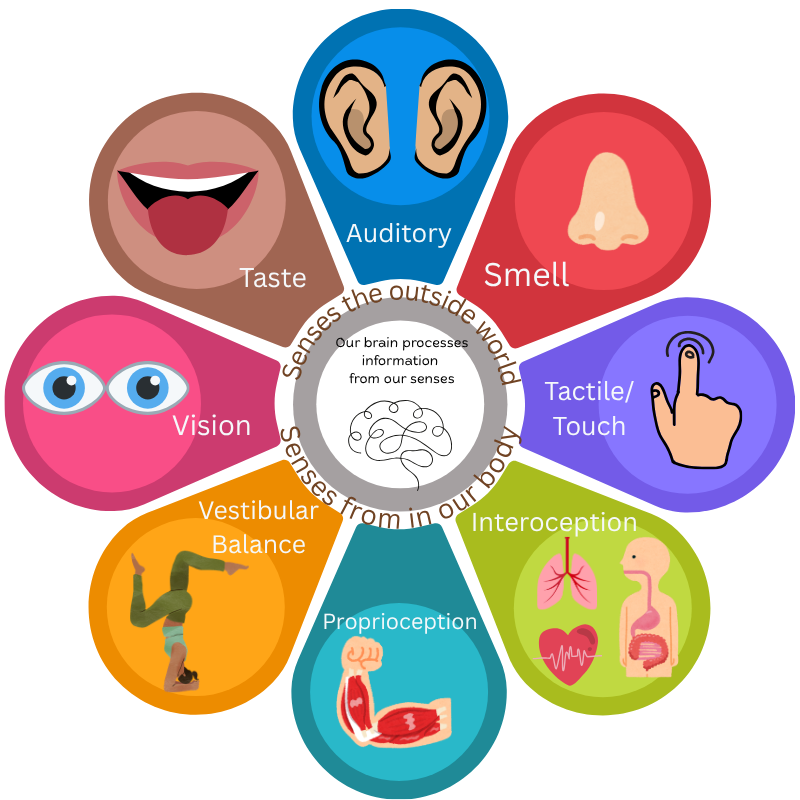
There are 8 sensory systems which inform our brain about the world around us and within us.
One sensory system that has received increasing attention in recent years is interoception—our ability to notice and interpret internal body sensations. Interoception allows us to recognize signals such as hunger, thirst, fatigue, temperature, muscle tension, breathing changes, heart rate, and emotional activation.
In many ways, interoception serves as the nervous system's internal monitoring system.
Strong interoceptive awareness helps individuals recognize the early signs of emotional states before they become overwhelming. A child may learn to notice that their stomach feels tight when they are anxious. A teen may recognize increased muscle tension before frustration escalates into anger. An adult may become aware of a racing heart and shallow breathing that signal rising stress.
Without accurate interoceptive awareness, emotions can feel as though they appear suddenly and without warning. Individuals often struggle to identify what they are feeling until the nervous system has already become significantly dysregulated.
Helping children and adults build awareness of internal body signals is therefore an important component of emotional regulation. When we can recognize what our bodies are communicating, we are better able to respond before stress reaches a breaking point.
Reflex Integration
Primary reflexes are among the earliest building blocks of nervous system development.
These automatic movement patterns emerge before birth and during infancy to support survival, sensory development, movement, and neurological organization. Reflexes are not mistakes that need to be eliminated. Rather, they serve as developmental stepping stones that help build the foundation for posture, balance, coordination, sensory processing, emotional regulation, and higher-level learning.
As development progresses, these reflexes should mature and become integrated into more complex nervous system networks. When this occurs, the nervous system gains greater flexibility, stability, and efficiency.
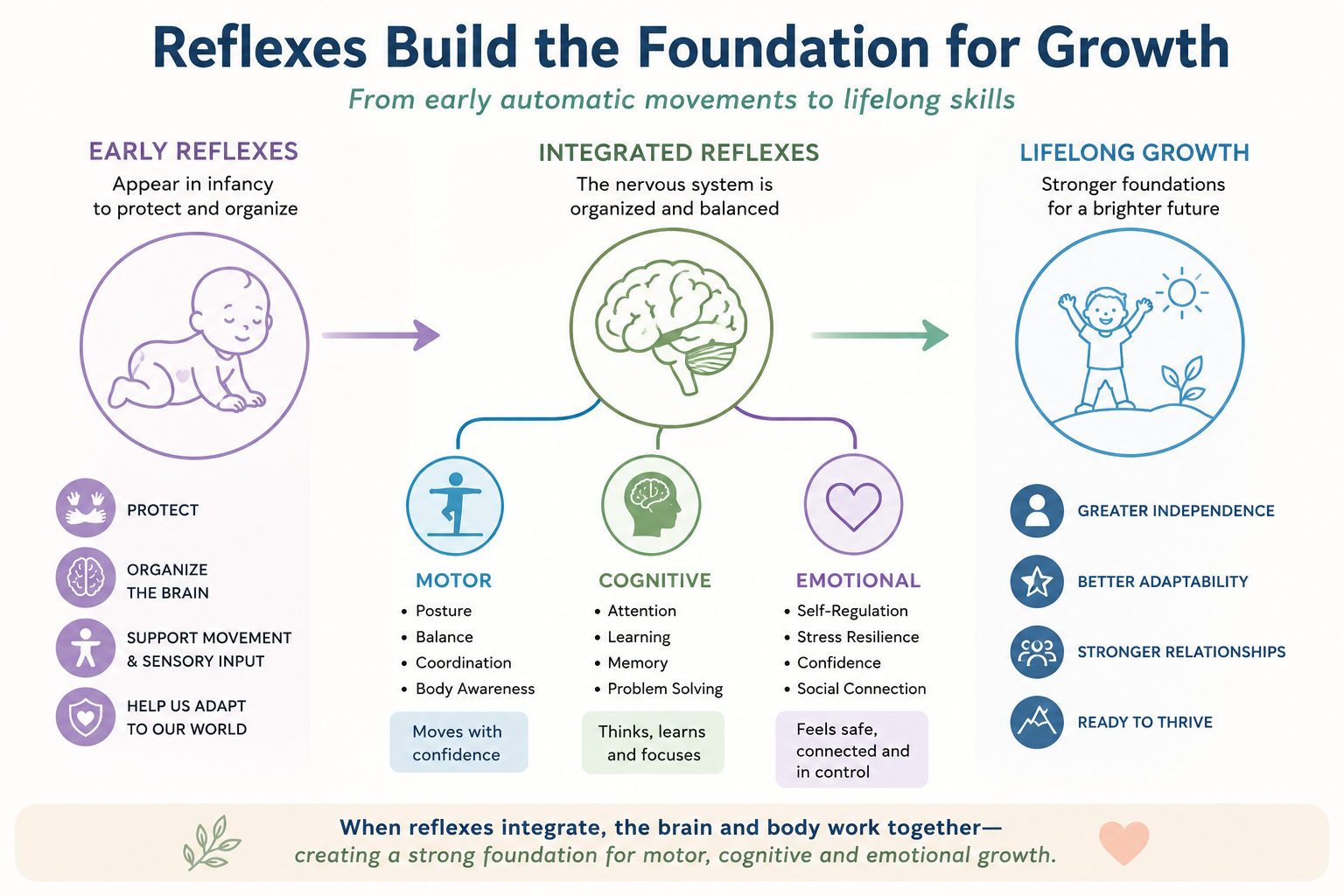
Lifelong growth is influenced by integration and maturity of infant reflexes
However, chronic stress, trauma, injury, illness, developmental challenges, sensory processing difficulties, or neurological immaturity can interfere with this maturation process. In some cases, reflex circuits may remain overly active. In others, they may become underactive and fail to provide adequate neurological support.
Dr. Svetlana Masgutova's research and clinical work have highlighted how reflex patterns continue to influence nervous system functioning throughout the lifespan. Rather than viewing reflexes as infant-only responses, her work emphasizes that reflex circuits remain part of the nervous system's protective architecture and can be used to increase resilience and a sense of safety.
Hyperactive Reflex Circuits
When reflex circuits remain overly active, the nervous system may continue responding as though protection is needed even when no immediate danger exists.
For example, an overly active Moro reflex can contribute to heightened sensitivity to movement and vestibular input. These individuals may appear anxious, easily overwhelmed, emotionally reactive, or hypervigilant because their nervous systems are continuously preparing for potential threat.
An active Fear Paralysis reflex may contribute to freezing, avoidance, social anxiety, perfectionism, difficulty initiating tasks, or intense worry about making mistakes. The nervous system becomes organized around caution and protection.
Hyperactive Asymmetric Tonic Neck Reflex (ATNR) may lead to difficulties crossing midline, processing auditory information, bilateral coordination needed to complete life skills tasks, and slower processing and learning.
When reflex circuits remain hyperactive, individuals often expend significant energy managing their internal state. They may appear highly reactive, anxious, impulsive, emotionally intense, or chronically stressed because the nervous system remains biased toward protection.
Hypoactive Reflex Circuits
Other individuals demonstrate reflex circuits that appear under-responsive or insufficiently developed.
For example, an underactive foot tendon guard system may contribute to low muscle tone, poor postural stability, decreased body awareness, or fatigue. The nervous system may struggle to generate enough activation to support efficient engagement with the environment.
Underactive hands supporting reflex responses may contribute to poor scapular stabilitiy needed for fine motor tasks, decreased flexibility both in joints and in thinking, and poor spatial and awareness of boundaries.
Some individuals appear disconnected from body sensations, struggle to recognize internal signals, or demonstrate low awareness of emotional and physical states. In these cases, the nervous system may not be receiving or organizing sensory information efficiently enough to support effective self-regulation.
Rather than appearing anxious or reactive, these individuals may appear withdrawn, passive, fatigued, inattentive, or disconnected.
Reflexes and Regulation
Whether reflex circuits are hyperactive or hypoactive, the result is often the same: the nervous system must work harder to maintain organization.
A child who melts down over small frustrations, constantly seeks movement, startles easily, avoids challenges, or struggles with transitions may be demonstrating signs of underlying reflex immaturity.
An adult experiencing chronic anxiety, muscle tension, overwhelm, fatigue, perfectionism, or difficulty recovering from stress may also be relying on protective reflex patterns that have remained active for years.
Reflex integration is not about suppressing reflexes. It is about helping the nervous system develop more mature, adaptive pathways that support flexibility, resilience, and regulation.
As reflex circuits become more balanced and integrated, many individuals experience improvements in emotional regulation, sensory processing, attention, posture, coordination, stress tolerance, and overall nervous system stability.
When the nervous system no longer needs to rely so heavily on primitive protective responses, it can devote more energy to learning, connection, problem-solving, and thriving.
Auditory Regulation Programs
The auditory system has direct connections to areas of the brain involved in arousal, attention, emotional regulation, and social engagement.
Therapeutic listening interventions based on the work of Dr. Alfred Tomatis, including auditory regulation programs, can help support nervous system organization by providing carefully structured sound input that influences autonomic functioning and sensory processing. Often these programs use both air and bone conduction to provide increased stimulation to the brain about the characteristics of sound. This helps to increase the ability of the muscles of the ear to “gait” sound as it enters the ear canal, which in turn can decrease auditory sensitivity and defensiveness. It also helps the brain to recognize and organize tones and pitch, which in turn helps decipher spoken language.
Rhythm and Breathing
Rhythm is one of the nervous system's oldest regulatory tools.
Long before language develops, rhythm organizes movement, connection, and physiological functioning. Think of a parent rocking a child - heartbeats, breathing patterns, walking rhythms, rocking, singing all provide predictable sensory experiences that support nervous system stability.
Breathing deserves special attention because it serves as a bridge between conscious and automatic nervous system processes. Cognitively remembering to take a deep breath can influence heart rate variability, autonomic regulation, and emotional state.
When combined with movement and connection, rhythmic experiences help the nervous system develop greater flexibility and resilience.
Hope, Neuroplasticity, and the Capacity for Change
Perhaps the most encouraging aspect of modern neuroscience is the understanding that the nervous system is capable of change throughout life.
For many years, scientists believed that meaningful neurological development largely ended in childhood. Today we know that the brain and nervous system remain adaptable across the lifespan through a process known as neuroplasticity.
New neural connections can form.
Existing pathways can strengthen.
Protective patterns can become more flexible.
Regulation can improve.
This does not mean change happens overnight. Nervous system development is rarely linear. Progress often occurs through thousands of small experiences that gradually teach the brain and body new ways of responding.
· A child begins tolerating transitions with less distress.
· An adult notices they recover from stress more quickly.
· Sleep improves.
· Body tension decreases.
· Sensory experiences become easier to manage.
· Relationships feel less overwhelming.

The nervous system can change throughout life.
These changes may appear small, but they reflect meaningful shifts in nervous system organization. The goal of neurodevelopmental work is not simply to eliminate symptoms. The goal is to build stronger foundations.
When the nervous system becomes more regulated, higher-level skills become more accessible. Learning improves. Emotional flexibility increases. Relationships deepen. Confidence grows. Individuals become more capable of navigating challenges without becoming overwhelmed by them.
This is why regulation matters.
Not because we want children to be compliant.
Not because we want adults to simply cope better.
But because regulation creates the foundation for thriving.
Beneath every behavior is a nervous system attempting to adapt. Beneath every challenge is an opportunity to build stronger neurological foundations. And when we support the nervous system through movement, sensory organization, co-regulation, reflex integration, rhythm, and connection, we create the conditions for meaningful and lasting change.