
Understanding what your child's nervous system may be telling us

A reflex assessment helps us understand how the nervous system organizes movement and responds to sensory information.
You've noticed that something isn't quite working the way it should. Maybe your child struggles to sit comfortably at the table, becomes overwhelmed by everyday situations, or works twice as hard as classmates to complete the same handwriting assignment. You've tried different strategies, perhaps even different therapies, but some of those challenges just don't seem to improve.
Then someone suggests a reflex assessment. You're probably wondering what testing reflexes has to do with handwriting, attention, emotional regulation, or your child's ability to ride a bicycle. After all, aren't reflexes something we check in babies or when the doctor taps our knee with a little rubber hammer?
The answer is a little more complicated, and much more interesting, than you might expect.
We're Looking for More Than Retained Reflexes
When I complete a reflex assessment, I'm not simply checking boxes to determine which reflexes are present and which have disappeared. I'm looking at how the nervous system responds to specific sensory information and how those responses may influence movement, posture, coordination, and regulation. More importantly, I'm looking for patterns that help explain why certain everyday activities might be harder than they should be.
Our developmental reflexes are automatic responses that begin forming before birth. They provide the foundation for early movement, protection, and interaction with our environment, gradually maturing as the nervous system develops greater control over movement and posture. If you haven't read my recent article, Understanding Developmental Reflexes, it explains how these early responses contribute to the development of more complex skills.
But reflexes don't simply become irrelevant once we learn to walk, talk, or write. The nervous system continues to use automatic responses throughout life, particularly those involved in protection, balance, and postural control. What changes with development is how those responses are regulated and coordinated with increasingly complex, intentional movements.
What Am I Actually Looking for During an Assessment?
Each reflex has a specific pattern of movement or response that occurs when the nervous system receives a particular stimulus. That stimulus might involve touch, changes in head position, movement through space, or pressure through the muscles and joints. By carefully observing the response, I can gather information about how the nervous system is organizing that input.
In the Masgutova Neurosensorimotor Reflex Integration (MNRI) approach, we look beyond whether a reflex can be triggered. We examine the quality of the response, its strength, timing, direction, and symmetry, along with how effectively the body organizes the movement. This gives us a more detailed picture than simply identifying a reflex as retained or integrated.
There are four general ways I describe reflex responses during an assessment:
Hyperactive: The response is stronger or more easily triggered than expected, sometimes producing excessive movement or muscle tension.
Hypoactive: The response is weak, the individual can not move through the pattern with control, suggesting that the expected motor pattern has not been fully activated enough times for the body to recongize and use the pattern.
Dysfunctional: A motor response occurs, but its direction, sequence, coordination, or other characteristics differ from the expected pattern.
Regulated: The response is appropriately organized for the individual's developmental stage, with effective coordination, timing, and control.
These distinctions matter because two children may demonstrate difficulties with the same reflex but show very different responses. Take the Spinal Galant reflex, for example. A child with a hyperactive response may demonstrate an exaggerated sideways movement of the trunk when the skin along the back is stimulated. Another child may show very little automatic response and also struggle when asked to intentionally bring the shoulder and hip toward each other, suggesting difficulty activating and coordinating that movement pattern.
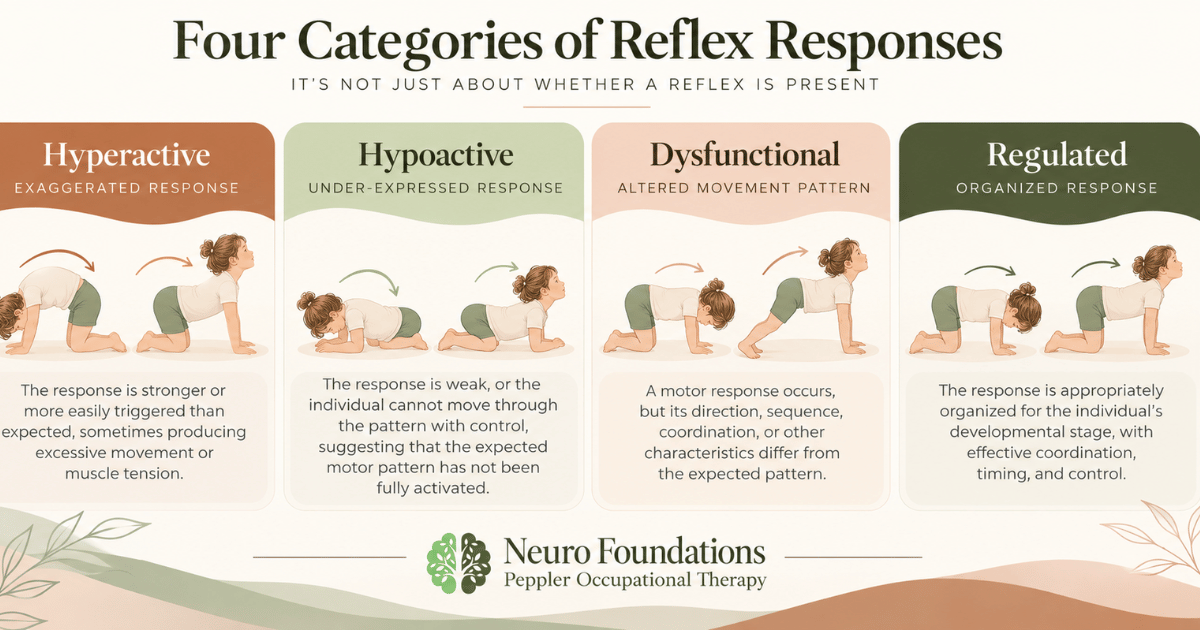
Reflex responses aren't simply present or absent. By observing how the body responds to movement, we can identify patterns that are exaggerated, underactive, poorly coordinated, or well-regulated. These differences offer valuable clues about how the nervous system organizes movement and supports everyday activities
Within the MNRI framework, these observations help us distinguish between an exaggerated response and one that is under-expressed or poorly organized. Both patterns may be associated with challenges in trunk coordination and postural stability, potentially contributing to compensatory movements during activities such as crawling, sitting, or maintaining balance. Although the functional difficulties may appear similar, the underlying movement patterns and therapeutic needs may be different.
What Does a Reflex Assessment Actually Look Like?
If you're imagining a series of complicated medical tests or asking your child to perform difficult exercises, you might be surprised by how simple many of the movements appear. Much of the reflex assessment takes place while the individual is lying comfortably on a treatment table, although some responses are evaluated while on hands and knees, standing, or moving. I use specific positions, gentle touch, and guided movements to observe how the body responds to different types of sensory information.
For example, I might gently turn a child's head to one side while observing what happens in their arms and legs, or apply light pressure to the hands or feet to evaluate a particular reflex response. Most activities involve asking the child to move through a specific pattern, while others allow me to observe the body's automatic response without requiring an intentional movement. I'm paying attention to much more than whether the movement happens, including muscle tension, coordination, symmetry, and how easily the body moves through the expected pattern.
Throughout the assessment, I'm also observing how the child responds to touch, changes in position, and the demands of the activities themselves. Do they have difficulty relaxing their muscles? Are certain movements uncomfortable or unusually challenging? These observations provide additional information about how the nervous system is processing sensory information and organizing movement.
The assessment isn't a test your child needs to pass, and there are no right or wrong answers they need to worry about. My goal is to understand how their nervous system is functioning right now, recognizing both their strengths and the areas where additional support may be beneficial. Each observation helps us build a more complete picture of the foundations supporting their everyday activities.

Simple movements and specific sensory input allow us to observe how the nervous system coordinates automatic and intentional responses.
What Can Reflexes Tell Us About Movement and Coordination?
Imagine a child who struggles with handwriting. Their teacher notices that they press too hard on the pencil, frequently change positions in their chair, and become tired after writing only a few sentences. They've practiced letter formation and pencil grip repeatedly, yet handwriting remains frustrating and exhausting.
During a reflex assessment, I might observe an exaggerated Asymmetric Tonic Neck Reflex (ATNR), an automatic response associated with turning the head. In early development, this reflex helps coordinate movements of the head, arms, and legs, contributing to early sensory and motor experiences. As voluntary motor control develops, children become increasingly able to turn their heads without unwanted movements in their arms and hands.
If that response remains unusually strong, turning the head may be accompanied by subtle changes in arm position or muscle activation. Imagine trying to write while your arm continually wants to respond to movements of your head, even when you're trying to keep your hand steady. The child may compensate by gripping the pencil tightly, leaning on the desk, or using additional effort to stabilize the body.
Does finding an exaggerated ATNR mean we've discovered the cause of the handwriting problem? Not necessarily. But when that finding occurs alongside difficulties with crossing midline, visual tracking, bilateral coordination, and postural stability, it becomes one important piece of the puzzle.
What About Balance, Posture, and Body Awareness?
Now consider a child who frequently trips, bumps into furniture, or avoids activities that involve balancing or climbing. They might appear clumsy, struggle to maintain an upright sitting position, or become uncomfortable when their feet leave the ground. Parents sometimes describe these children as constantly moving, while others seem unusually cautious about movement.
In addition to assessing reflexes, I look closely at the vestibular and proprioceptive systems. The vestibular system, located in the inner ear, helps us understand movement and our relationship to gravity, while proprioception provides information about where our body parts are and how much force our muscles are using. Together, these systems help the nervous system maintain balance, adjust posture, and coordinate movement without requiring constant conscious attention.
Reflexes such as the Tonic Labyrinthine Reflex (TLR), along with postural and protective responses, can provide additional information about how the body organizes itself in response to gravity and movement. If I observe unusual reflex responses alongside poor balance, difficulty coordinating both sides of the body, or reduced postural endurance, I begin considering how these systems may be interacting. The goal is to understand what makes movement difficult rather than simply labeling the child as clumsy.
Can Reflex Assessments Help Us Understand Emotional Regulation?
This is often where parents become particularly interested, because the challenges they're seeing may have little to do with movement. Their child might startle easily, become overwhelmed in noisy environments, have difficulty with transitions, or take a long time to recover after something unexpected happens. Sometimes these children seem constantly on alert, even when there is no obvious reason to feel threatened.
Our nervous system is continually gathering information about the environment and determining how to respond. Protective reflexes, including the Fear Paralysis and Moro reflex, are part of our early biological response systems and are closely connected with the body's ability to react to sudden changes. These automatic protective mechanisms develop alongside the broader systems responsible for arousal, stress responses, and emotional regulation.
During an assessment, an unusually strong protective response may be one observation worth investigating, particularly when a child also demonstrates sensory sensitivities or difficulty recovering from unexpected experiences. However, a reflex finding alone cannot tell us whether a child feels safe, identify the cause of anxiety, or explain every emotional response. We need to consider the child's experiences, sensory processing, relationships, environment, and overall regulation abilities.
For example, a child who reacts intensely when someone unexpectedly touches their shoulder may be demonstrating tactile sensitivity, an elevated state of arousal, or several interacting factors. Looking at protective reflex responses alongside sensory processing and functional behavior can help us develop a more complete understanding. That understanding allows us to choose interventions that support regulation rather than simply expecting the child to control a response they may not yet have the skills to manage.
Why I Don't Stop With the Reflex Assessment
One of the most important things I want parents to understand is that a reflex assessment is only one part of a comprehensive neurodevelopmental evaluation. A reflex finding tells me something about an automatic response, but it doesn't automatically explain why your child struggles with reading, handwriting, attention, or emotional regulation. Those activities depend on many interacting systems, and we need to look at how those systems are functioning together.
Depending on the individual's concerns, my evaluation may also include assessment of visual tracking and eye movements, vestibular processing, balance, bilateral coordination, motor planning, proprioception, sensory modulation, and postural control. I also consider developmental history, medical information, and the challenges that brought the family to my office in the first place. Sometimes what appears to be a single problem is actually the result of several systems working harder than they should.
For example, a child who avoids reading may have difficulties with visual tracking, maintaining attention, postural endurance, or some combination of these challenges. Another child with similar reading difficulties may demonstrate an entirely different pattern. The assessment helps us identify which areas warrant further investigation and where therapeutic support may be most useful.
How Does This Information Change Treatment?
Once we've identified patterns of difficulty, the next question becomes what to do with that information. I don't want families leaving an evaluation with a long list of reflexes and no understanding of how those findings relate to everyday life. The purpose of assessment is to help us make thoughtful decisions about treatment.
Within my MNRI training, I use specific sensory and movement-based techniques intended to support more organized reflex responses. These may be combined with activities addressing balance, postural stability, bilateral coordination, visual-motor skills, and sensory regulation. The treatment plan is individualized because the same outward difficulty can have very different contributing factors.
Just as importantly, we establish functional goals that matter to the individual and family. Perhaps the goal is to complete handwriting assignments with less fatigue, participate in playground activities with greater confidence, tolerate everyday sensory experiences more comfortably, or recover more easily after becoming upset. We monitor those changes alongside clinical findings to determine whether the intervention is making a meaningful difference.
Reflex-based interventions are an area of ongoing research, and we still have important questions about which approaches are most effective and for whom. That is why I believe it is important to evaluate both the quality of the reflex responses and the person's actual participation in daily activities. Improvement on an assessment is encouraging, but meaningful progress must also show up in everyday life.

Sensation guides movement, and movement gives the nervous system new information about the body.
An Assessment Is a Starting Point, Not a Label
Sometimes parents arrive at an evaluation feeling that they've already tried everything. Their child has received therapy, practiced skills, worked with teachers, and made progress in some areas, but other challenges remain. They're not necessarily looking for another diagnosis; they're looking for a better understanding of what might be making life so difficult.
A comprehensive assessment gives us an opportunity to look at development from a different perspective. Instead of focusing only on the skill that isn't working, we examine the sensory, motor, postural, and regulatory foundations that support that skill. Reflex responses are one part of that investigation, helping us identify patterns that may otherwise be overlooked.
No single reflex tells the whole story, and no assessment can predict everything a child will achieve. But when we combine careful observation, clinical reasoning, and an understanding of the individual's everyday experiences, we can begin building a treatment plan that addresses more than the symptoms we see on the surface.
The goal isn't simply to change a reflex response. It's to help the nervous system develop the organization and flexibility needed for greater independence, comfort, and participation in everyday life.
If your child continues to struggle despite practice, support, or previous therapies, a comprehensive neurodevelopmental evaluation may help identify areas that haven't yet been fully considered. At NeuroFoundations, we look at how the nervous system's foundational skills contribute to everyday function and use those findings to develop an individualized plan. Learn more about our evaluation process or schedule a consultation.