
When Everyday Tasks Feel Hard
Understanding Developmental Infant Reflexes

Everyday movement draws on a foundation of sensory information, posture, and coordination.
A child knows what to do, but getting it done is hard. Sitting through homework takes constant shifting, handwriting leaves the hand tired, or an unexpected sound turns an ordinary moment into distress. Reflex integration offers one way to look beneath those struggles and consider whether early movement responses are affecting the foundation for more comfortable, coordinated participation. Understanding reflexes helps us ask what the nervous system needs before asking a child to try harder.
We often notice the finished skill before we notice the work underneath it. Writing requires a steady trunk, coordinated eyes, and hands that can move without the whole body joining in. Managing frustration also depends on how readily the nervous system responds to change and how effectively it settles afterward. When those foundations take extra effort, everyday expectations can become exhausting, even for a bright, motivated child.
While research in this area is still emerging, there is growing evidence that retained primitive reflexes can be associated with functional difficulties — and that movement-based interventions may help support development. My goal is to help parents understand those connections in language that makes sense at home, with research links available for anyone who wants more detail. We will look at why reflexes develop, how their role changes, and what their responses can tell us about function. The central question is how to help the nervous system support the abilities that matter in daily life.
Why Babies Need Reflexes
Babies need to respond to the world long before they can decide how to move. A touch near the mouth helps a newborn turn toward feeding, and pressure in the palm can trigger the fingers to close. A sudden change in support can produce the familiar Moro response, with the arms opening and then coming back toward the body. These automatic responses give the infant immediate ways to respond while more deliberate control is still developing.
A reflex begins with sensory information, such as touch, pressure, or a change in position. The nervous system processes that information and produces a particular response, often involving muscles and movement. Different reflexes use different pathways, so their triggers and responses are specific. This sensory information, nervous system processing, and motor response form a automatic working circuit rather than three separate developmental tasks.
Reflexes also give the baby repeated experiences of the body in motion. Turning the head changes what the infant sees and how the limbs are positioned, while grasping creates contact and pressure through the hand. Movement brings new sensory information back to the nervous system, which helps build body awareness and coordination. Reflex activity is part of the foundation from which increasingly varied movement develops, alongside spontaneous movement and interaction with caregivers.
The First Movement Experiences Begin Before Birth
Many early reflex responses begin developing during pregnancy and are available by the time a full-term baby is born. Others emerge later, as the infant gains new ways of responding to gravity and support. There is a sequence, but each response has its own developmental course. The purpose of understanding that sequence is to see how early abilities prepare the body for the next demands.
Birth is a rich sensory and movement experience. During vaginal delivery, the infant encounters pressure, compression, changes in position, and rotation of the head and trunk. Reflex integration practitioners connect these experiences with activation of patterns such as ATNR, Spinal Galant, and trunk extension; the transition into life outside the womb also brings new changes in support that can elicit Moro. Within a developmental model, birth is one important experience that has already begun and will continue through feeding, handling, movement, and connection.
In the Brains in Motion ATNR episode, Dr. Mary McKone and Dr. Angela Zielinski discuss how rotation and compression during birth may engage early movement patterns. Their clinical perspective is that a cesarean birth, unusually rapid delivery, or difficult birth can alter opportunities for those patterns to be activated and expressed. Within that explanation, reduced or uneven activation may leave the infant needing more support as movement develops. This is a proposed developmental connection informed by clinical observations, rather than a demonstrated research link between birth method and later reflex maturation.
For parents, this history can help make sense of questions asked during an evaluation. A therapist may ask about pregnancy, delivery, early feeding, preferred head positions, or how easily the baby tolerated movement. Those details provide context for looking at the child's current sensory and movement responses. The useful next step is to connect that history with what the child needs now and create supportive experiences that move development forward.
Each developmental reflex has a particular role in helping an infant respond to sensory information, organize movement, or develop greater control over the body. Although researchers have identified typical ages when many early reflex responses appear and become less prominent, these timelines are guides rather than rigid deadlines. The table below introduces several commonly discussed developmental reflexes, their early purpose, and the changes we expect to see as the nervous system matures.
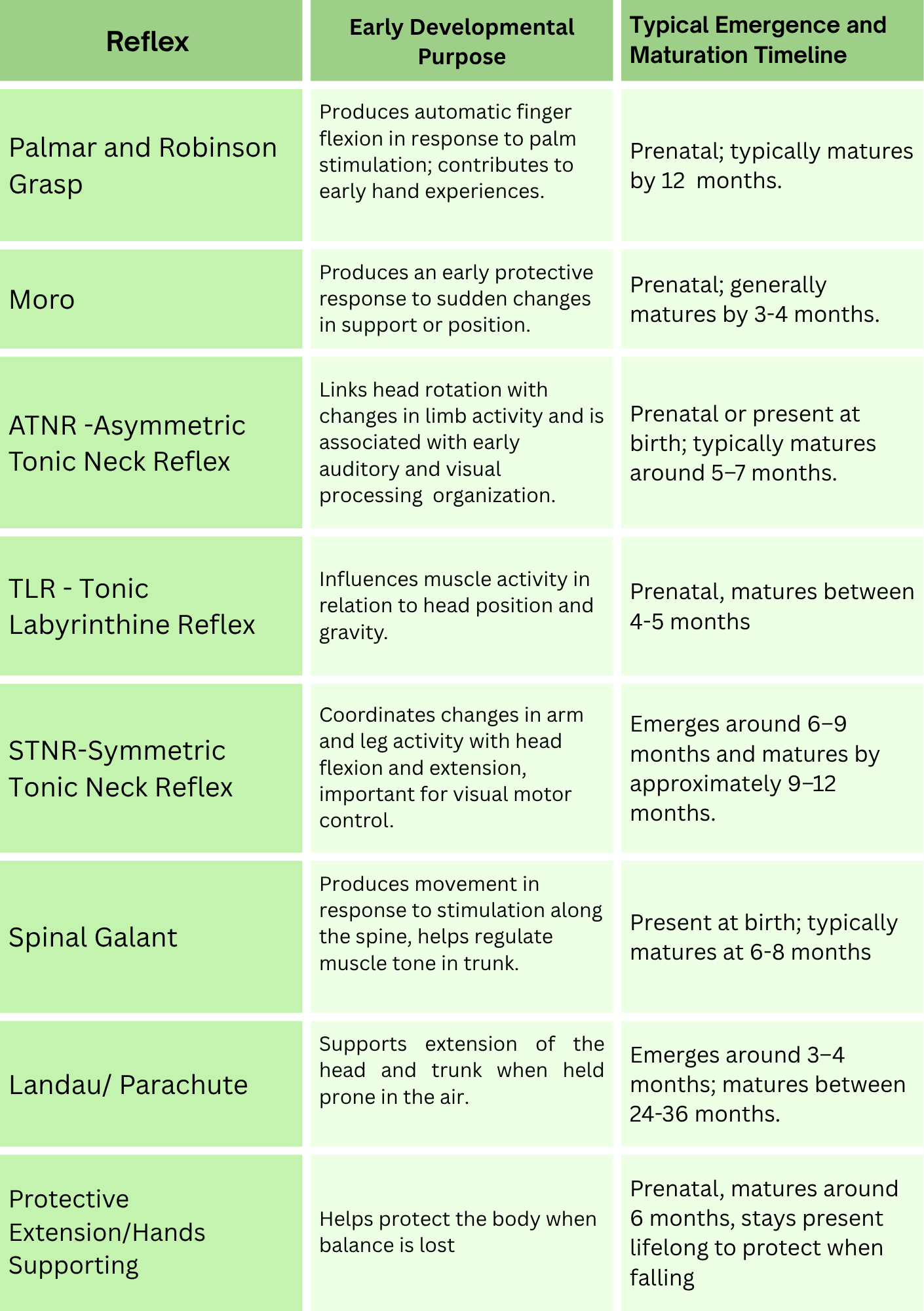
Timelines are approximate and depend on the specific testing method. They describe when recognizable infant responses usually become less prominent, not when their underlying neural circuits disappear. Some reflexes, particularly TLR and STNR, have less consistently defined developmental timelines across sources.
Primitive or Primary: Making Sense of the Language
You will often hear primitive reflexes and primary reflexes used interchangeably. In general medical and research language, primitive reflexes usually refers to early automatic responses that become less readily elicited as voluntary control develops. The word primitive describes an early developmental organization; it does not mean unimportant or defective. These responses belong to the nervous system's beginning foundation.
Within the Masgutova Neurosensorimotor Reflex Integration approach, or MNRI, primitive and primary can refer to different phases of a reflex's development. The primitive phase describes the earliest expression, while primary patterns are considered through their ongoing organization and maturation. MNRI describes a seven-phase developmental model, with broad distinctions among primitive, primary, and postural development. In my clinical work, the focus is primarily on supporting primary and postural patterns as part of a developing nervous system.
That terminology matters because it changes what we imagine therapy is doing. If we think only of an infant response that should disappear, treatment can sound like an attempt to remove something unwanted. A developmental perspective asks how the sensory and motor components are organized and how they contribute to more advanced control. Parents do not need to memorize the phases to understand that the goal is a more reliable foundation for function.
How Reflexes Mature: From Automatic Movements to Functional Skills
Research often uses inhibition to describe the reduced expression of early reflex responses as the nervous system matures. In this context, inhibition means that developing networks regulate an automatic response so it does not dominate movement. That is a real part of neurological development. In therapy, however, simply getting a smaller response during testing does not capture everything we want a person to gain.
Consider a baby whose head turn is accompanied by the characteristic ATNR pattern in the limbs. Over time, the child needs to turn the head while keeping both hands on a toy, reach across the body, and look to one side without losing balance. These abilities require the nervous system to separate and coordinate movements that were once more closely linked. Maturation brings flexibility: the child can use the head, trunk, and limbs together or independently as the task requires.
This is why I describe reflex integration as supporting maturation rather than simply suppressing movement. We want sensory information to lead to an organized response, with useful automatic support and greater voluntary choice. A child should be able to look toward the teacher without the pencil hand becoming disrupted or maintain balance while reaching for a dropped item. The outcome we care about is easier, more adaptable participation.
How the Body Learns to Stay Steady
Postural control is the body's ability to organize itself against gravity and stay supported during movement. It develops as babies gain head control, roll, reach, sit, and move between positions. Some postural reactions begin emerging around two months, with additional responses developing through the first year and beyond. This progression helps the child manage increasingly complex demands without consciously planning every adjustment.
The term postural reflex has a somewhat different scope across professional frameworks. In medicine, it commonly refers to righting, protective, and equilibrium reactions, including responses that support posture throughout life. In reflex integration practice, it may also describe a broader group of patterns considered important for movement, alignment, and support against gravity. Knowing which meaning is being used helps parents follow the conversation when different professionals use the same word.
Within that broader framework, ATNR relates to head turning and coordination between the sides of the body, while TLR relates head position to changes in muscle tone. STNR links head movement with flexion and extension patterns in the arms and legs, and Landau involves extension of the head, trunk, and legs in supported prone positioning. Hands Supporting, often discussed alongside the parachute response, involves bringing the arms forward to provide protection and support. Trunk Extension and the MNRI Bonding pattern are also considered within that approach's discussion of postural organization, with Bonding connecting movement and relational contact.
These names become more meaningful when we connect them with daily life. Postural support helps a child sit at a table, keep the eyes directed toward a page, and free the hands for writing or building. Protective responses help the child bring the arms forward when balance is lost. As those foundations develop, more attention can be available for the activity itself instead of the effort of staying upright.
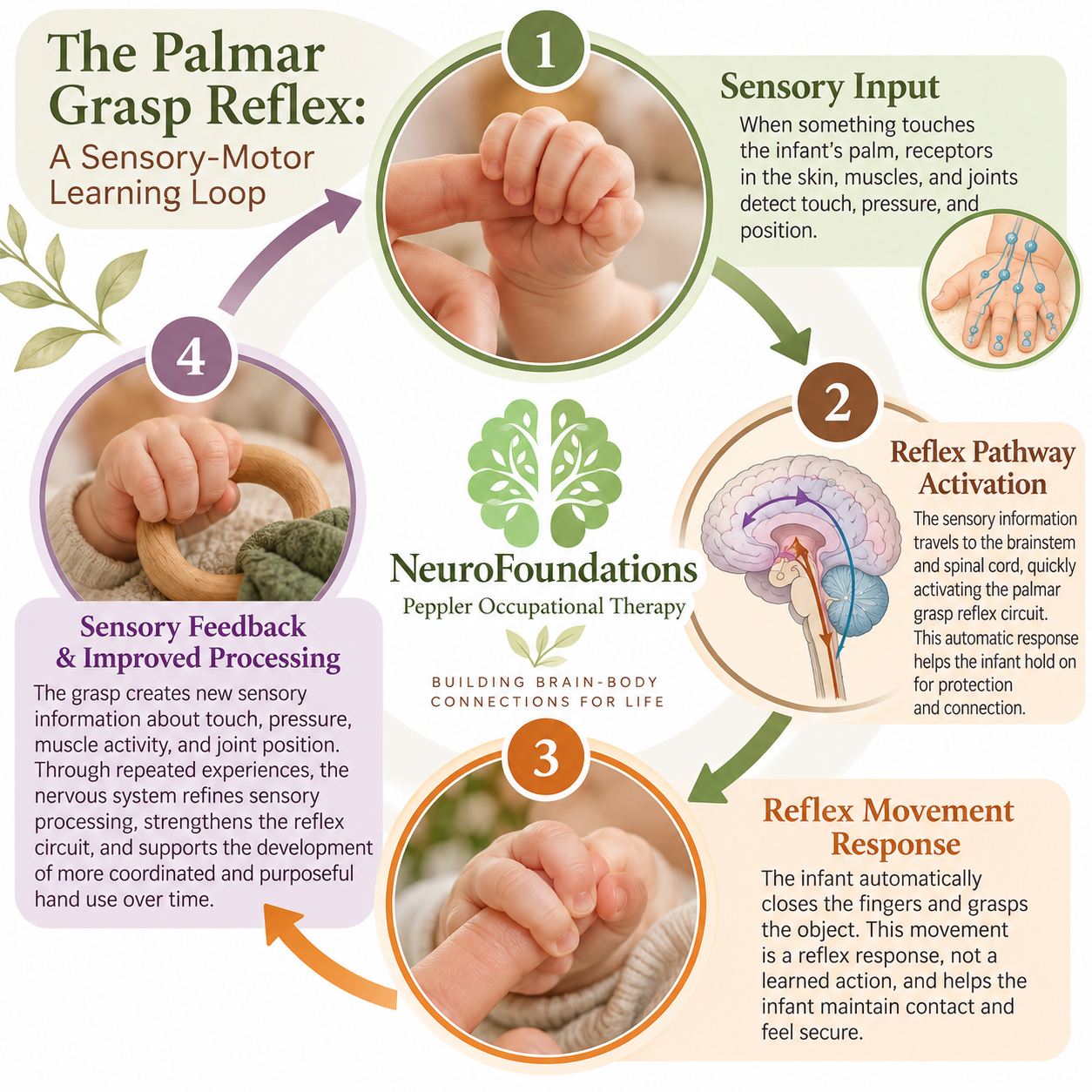
Sensation guides movement, and movement gives the nervous system new information about the body.
How Sensation and Movement Build On Each Other
A reflex response is brought about through receiving and responding to sensory information. Touch can trigger a grasp, changes in head position influence tonic neck responses, and information about gravity helps organize muscle activity. The vestibular system tells us about head movement and balance, while proprioception provides information from muscles and joints about position and effort. These systems are continuously involved in how the nervous system prepares and adjusts movement.
The relationship works in both directions. Sensory information activates a response, and that response changes the information coming back from the body. When an infant pushes against a surface, the hands and shoulders receive pressure while the head moves relative to gravity. Those linked experiences give the nervous system opportunities to coordinate sensation with action, making the connection increasingly useful for reaching, supporting weight, and changing position.
In reflex integration work, I therefore look at more than the visible movement. I want to know how the person registers the stimulus, whether the response is organized, and how comfortably they can stay engaged. A child who startles with movement may need slower changes in position and predictable support before a new activity becomes manageable. The aim is to help sensory information and movement become a more dependable partnership.
Looking Beyond Whether a Reflex Is Retained
Saying that a reflex is retained gives us only part of the picture. Before deciding what to do, we need to describe the quality of the response: its strength, timing, symmetry, direction, and relationship to the stimulus. In reflex integration practice, terms such as hyperactive, hypoactive, and dysfunctional help describe those differences. I discuss this more fully in What Do We Mean When We Say a Reflex Is Integrated, which looks beyond a present-or-absent checklist.
A hyperactive response is too readily triggered, too strong, or difficult to regulate for the situation. A hypoactive response is under-expressed, with less of the expected movement or support available. A dysfunctional response is poorly organized, such as movement in an unexpected direction or a response that resembles a different pattern. These descriptions tell us what was observed; they guide questions about the support the nervous system needs.
Two people can have difficulty with the same task while showing very different responses. One may recruit excessive tension when the head turns, while another struggles to generate enough organized support to maintain the position. The concern is how strongly the response occurs, whether it is appropriate to the stimulus, and whether it interferes with function. Those observations keep the assessment connected to everyday participation rather than a label alone.
What Reflex Difficulties Can Look Like At Home and School
Imagine a child who understands the homework but begins leaning on one arm, wrapping the feet around the chair, and pressing hard with the pencil. The child pauses frequently, shakes out the hand, and asks to stop after only a few lines. If head movements pull the arms or trunk into an automatic pattern, stabilizing the body and controlling the pencil can take extra effort. The visible problem is handwriting, but the evaluation also needs to consider the movement foundation supporting it.
A 2022 occupational therapy study of 74 children ages seven to nine found an association between retained reflex scores and handwriting difficulty, even after accounting for vision. That finding helps explain why looking at reflex responses can be useful when a child continues to struggle with writing. In therapy, I would connect assessment findings with how the child sits, looks, reaches, and uses the hands during the actual task. Progress should include writing with less effort and greater participation, alongside changes in the underlying responses.
Now consider a child who becomes distressed when a room gets noisy or another person brushes past unexpectedly. The shoulders rise, the body stiffens, and the child quickly moves into crying, pushing away, or trying to control what happens next. From a reflex integration perspective, protective responses are part of what we assess when the nervous system appears to move into defense very readily. The practical question is how to help that child feel supported enough to respond with more flexibility.
Clusters of behaviors can help identify which reflex patterns may need to be checked. Postural fatigue, difficulty coordinating both sides, and changes in hand control with head movement provide a different set of clues than strong startle responses and difficulty recovering after unexpected input. Looking at the cluster gives the therapist a direction for assessment. It also helps parents describe specific situations instead of feeling limited to words such as clumsy, inattentive, or overly sensitive.
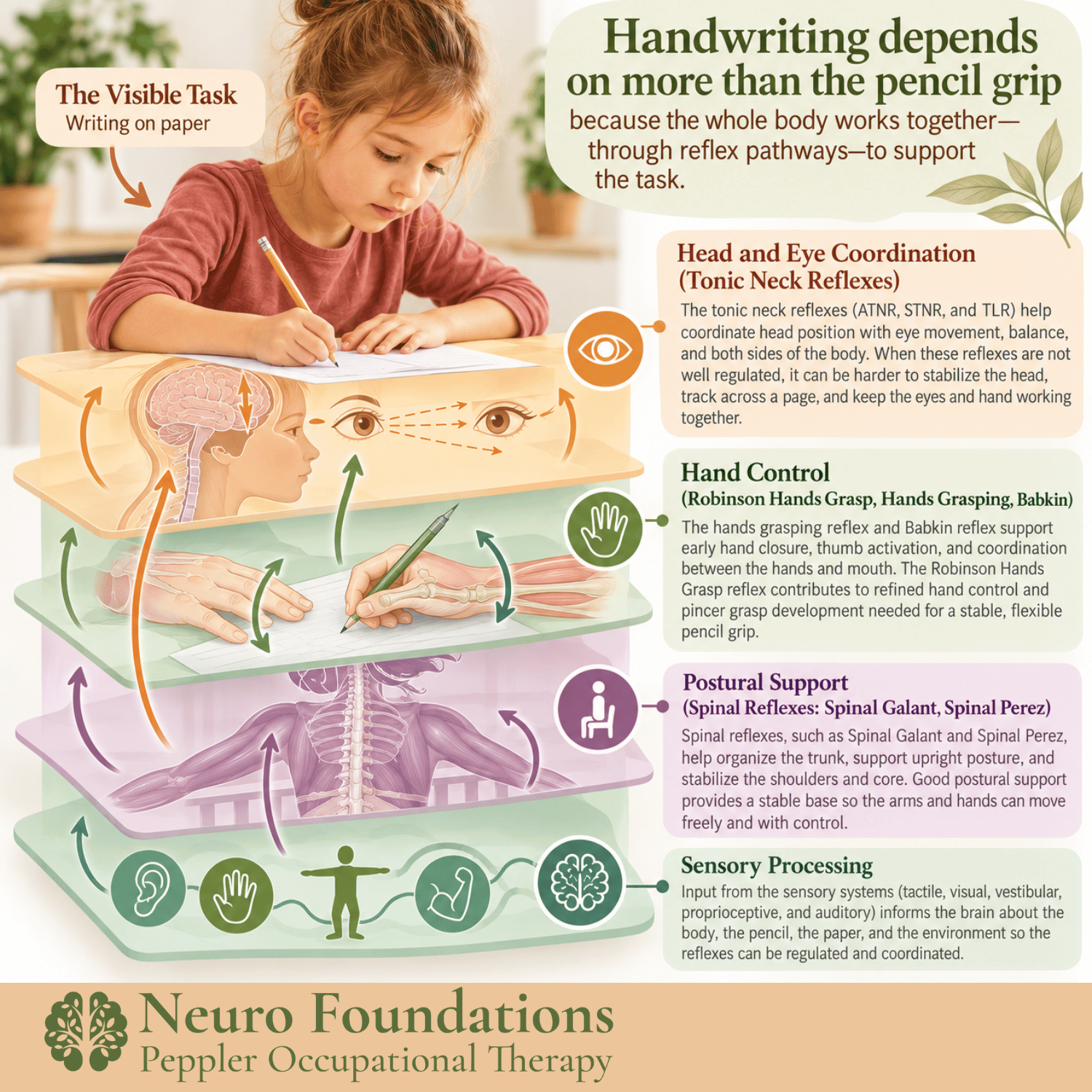
Handwriting depends on more than pencil grip. Reflex pathways support the posture, visual coordination, hand control, and sensory processing needed for efficient, comfortable writing. When these systems work together efficiently, children have greater freedom to focus on forming letters, organizing their thoughts, and communicating through writing.
When Stress Brings Protective Patterns Forward
Under extreme stress, the nervous system prioritizes protection and can rely more heavily on automatic responses. Emotional trauma, illness, injury, and exhaustion can change how readily a person startles, braces, withdraws, or loses access to familiar skills. From a reflex integration perspective, this can look like the body recruiting an earlier protective movement pattern again. The response serves an immediate protective purpose, even when it does not fit the present situation well.
A previously comfortable activity may then feel harder because the body is organizing around defense. Someone may tense during movement, become less coordinated, or need more reassurance and physical support. This clinical description of protective patterns is different from a medically confirmed return of infant reflexes after neurological injury. Understanding the distinction helps us describe what we see accurately while still responding to the person's need for safety and support.
The first step is to make participation manageable again. Predictable contact, comfortable movement, co-regulation, and carefully graded activities can help the person experience support while regaining control. When reflex assessment identifies a poorly regulated pattern, targeted work can be included to help organize that response. The goal is to restore access to coordinated movement and regulation as the person recovers.
How Purposeful Practice Builds Greater Control
Repetition matters because the nervous system learns through experience. In reflex integration work, activities are designed to engage relevant sensory and motor components in a supported, controlled way. The person practices maintaining alignment, separating movements, adjusting effort, and responding without being pulled into an unwanted automatic pattern. As control improves, the activity can become more varied and more closely connected to everyday demands.
For example, a child may begin with support to turn the head while keeping the trunk and arms steady. Later, the same ability can be practiced while reaching, catching, or looking between a board and a worksheet. The repetitions are purposeful because they build toward using movement with greater choice. Quality, comfort, and appropriate challenge matter as much as the number of times an activity is completed.
Learning involves changes in connections between nerve cells and in how networks coordinate their activity. Myelin, the insulating material around many nerve fibers, also helps messages travel efficiently, and animal research has linked new myelin formation with learning motor skills. That research provides biological context for movement practice, rather than proof that a particular reflex exercise myelinates a specific pathway. Clinically, we follow the changes we can observe: smoother movement, better coordination, and more reliable function.
What Recent Research Tells Us
Recent studies are beginning to measure movement outcomes alongside reflex responses. In a 2025 study, 27 children with autism or ADHD completed a 12-week program involving rhythm, balance, and coordination. Researchers reported improved fine motor coordination in both groups, improvement in one ATNR measure in the autism group, and improved parent-rated behavior in the ADHD group. These findings make the conversation more concrete by connecting assessment changes with abilities that families recognize.
A July 2026 study followed 27 autistic children through a 12-week exercise program targeting ATNR, STNR, and TLR. The authors reported improvements in motor proficiency, sensory and behavioral scores, and reflex responses after the program. Both studies compared participants before and after intervention without an untreated comparison group, so their findings are promising early evidence. They support continued investigation of movement-based approaches and careful attention to functional outcomes in practice.
Why Reflex Support Needs To Be Individualized
A program that assigns the same activity for the same reflex, repeated the same number of times for the same number of weeks, can miss important differences between individuals. Response quality, sensory tolerance, physical abilities, fatigue, and opportunities for practice all influence what is appropriate. An activity that helps one child organize movement may be too demanding or insufficiently challenging for another. Assessment and ongoing adjustment help make the work fit the person.
MNRI is one approach I use within that individualized process. Its perspective emphasizes organizing the sensory and motor components of primary and postural patterns and supporting their maturation into more adaptable function. It helps frame questions about hyperactive, hypoactive, and dysfunctional responses rather than assuming that every response needs to be suppressed. The broader purpose remains helping the person gain comfort, control, and participation in daily life.
An individualized home program should fit family routines and preserve the child's comfort and participation. Short, consistent opportunities may be more sustainable than a long routine that creates conflict. Parents should know what to observe, when to modify an activity, and how to report changes. The program should support family life while helping the child practice abilities that matter.
Helping Support The Body: What Comes Next?
When tasks remain hard, looking at reflex development can open another useful conversation about the nervous system. We can become more specific about the effort underneath handwriting, posture, coordination, and regulation, then connect those observations with an individualized plan. The purpose is to help a child or adult gain more reliable support from the body. That support can create room for learning, connection, and greater independence.
If you recognize these patterns in your child or yourself, start by noticing when activities become difficult and what the body does in those moments. Bring those examples to a professional who can assess reflex responses alongside sensory processing, movement, and everyday function. A neurodevelopmental evaluation can help clarify where support is needed and what meaningful progress would look like. Contact me to discuss your concerns and the next step toward a stronger foundation.