
Reflex Integration: What Do We Mean When We Say a Reflex Is “Integrated”?

Strong foundational reflex patterns support the coordination, balance, and postural control needed for increasingly complex movement.
If you have spent any time learning about reflex integration, you may have heard someone say that a child has an “unintegrated,” “retained,” or “active” reflex. These terms can sound concerning, particularly when no one has explained what an integrated reflex actually looks like or what the reflex is supposed to do. Parents may leave an evaluation believing that the goal of therapy is simply to make certain reflexes disappear. Reflex development, however, is much more dynamic than a present-or-absent checklist.
Reflexes are part of the nervous system’s earliest foundation for movement, protection, sensory processing, and interaction with the world. As the brain and body develop, these early patterns are intended to mature and become incorporated into increasingly complex movement and nervous system organization. Integration does not mean that the nervous system simply gets rid of a reflex. Instead, a well-integrated reflex is available to support the body appropriately without unnecessarily interfering with more mature movement, regulation, and function.
Primitive Reflex Integration Is a Developmental Process
Babies arrive with an incredible neurological system already at work. Early reflex patterns help an infant respond to touch, gravity, changes in head position, feeding demands, and the need for protection long before voluntary movement is fully developed. Through repeated sensory and motor experiences, the nervous system gradually builds more complex patterns upon this early foundation.
This is why I think of primitive reflex integration as a developmental process rather than an on/off switch. As an infant gains head control, rolls, reaches, crawls, sits, stands, and eventually walks, early reflex patterns contribute pieces of information that are incorporated into increasingly sophisticated movement. The nervous system is not simply discarding its early programming—it is organizing it so that the child has greater choice, adaptability, and control.
Think about learning to drive a car. At first, you consciously think about where your hands are positioned, how hard you are pressing the accelerator, when to brake, and where to look. With experience, those individual processes become organized into a much larger automatic pattern, allowing you to drive while simultaneously monitoring traffic, navigating, and talking with a passenger. Neurological development works differently, of course, but the analogy helps illustrate an important idea: foundational patterns become useful components of something more complex.
Retained Reflexes: More Than Present or Absent
The phrase retained primitive reflexes is commonly used to describe reflex patterns that continue to influence movement or behavior beyond the developmental period when greater neurological organization would typically be expected. Within the Masgutova Method, however, reflex development is understood with more specificity. The primitive phase is the earliest phase of reflex development, beginning with reflexes present at birth, and these patterns then transition through additional developmental phases. In my clinical work, I am therefore primarily assessing and supporting the development of primary and postural reflex patterns, rather than attempting to eliminate or change a primitive reflex.
This distinction also changes how we think about an “unintegrated” reflex. A reflex is not simply present or absent; its sensory-motor circuit can be functioning in very different ways. A hyperactive reflex responds too readily or too intensely, and this is often what people are describing when they use the term “retained reflex.” The nervous system may access that response so quickly that the reflex pattern begins to interfere with more mature movement, regulation, or functional skills.
A hypoactive reflex presents a different problem. Rather than simply being a “weak” reflex, the underlying sensory-motor pattern may not have been activated and expressed often enough during development for the neural pathway to become sufficiently established and myelinated. When that foundational movement pattern has not become automatic, the nervous system has a less stable foundation upon which to build increasingly complex motor and functional skills.
A dysfunctional reflex means that stimulation of the reflex produces a motor response, but not the motor response expected for that particular reflex circuit. Sometimes the movement that appears looks more like the response associated with another reflex pattern, suggesting that the nervous system has access to movement but is not organizing the sensory input through the expected pathway. Clinically, this gives us different information than either a hyperactive or hypoactive response and helps guide what the nervous system may need in order to develop a more organized foundation.
These distinctions matter because two children can demonstrate a response during the same reflex assessment while having very different neurological needs. One child's nervous system may be responding too strongly, another may not yet have adequately developed the pathway, and another may produce a completely different motor response than expected. Rather than asking only, “Is the reflex still there?”, I want to understand how that reflex circuit is functioning and whether it is providing a reliable foundation for the higher-level skills that develop from it.
How Reflex Development Can Affect Everyday Function
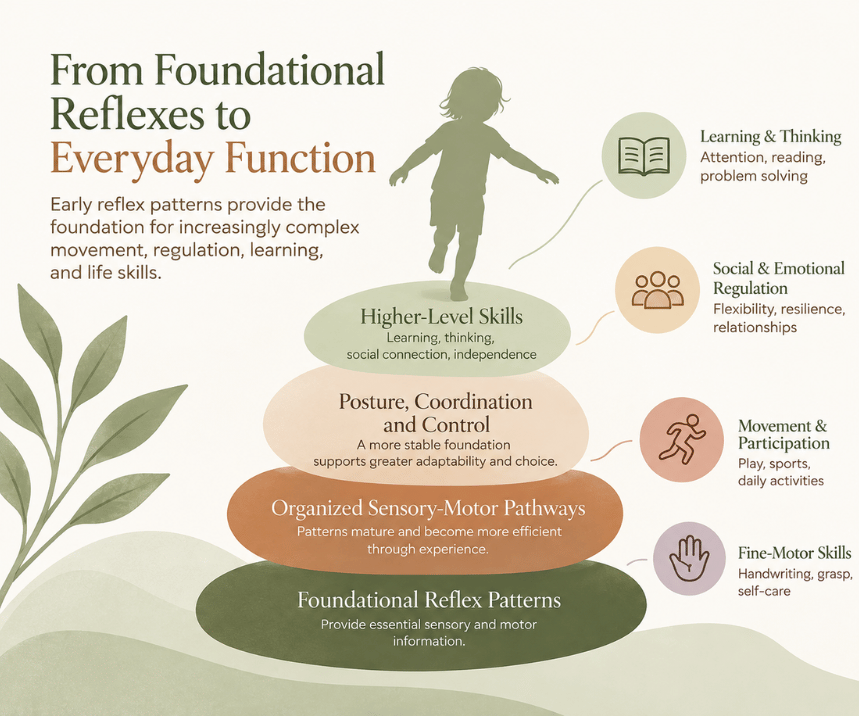
Foundational reflex patterns support the sensory-motor pathways upon which posture, coordination, regulation, learning, and everyday skills continue to develop.
Reflex patterns do not exist in isolation. They interact with sensory processing, postural control, motor planning, emotional regulation, attention, and the body's protective systems. When a foundational pattern requires too much neurological effort—or responds too strongly—the child may have fewer resources available for the complex demands of everyday life.
For example, an overly reactive protective reflex pattern may contribute to a nervous system that moves into a defensive response very quickly. A child may become overwhelmed by unexpected touch, transitions, frustration, noise, or changes in the environment and appear impulsive, emotional, avoidant, or controlling. The behavior we see on the outside may be occurring alongside a nervous system that is working very hard to determine whether the body is safe.
Postural reflex development can also influence how efficiently a child uses the body against gravity. A child who uses excessive effort to maintain a seated position may constantly shift, lean on the desk, wrap the feet around the chair, or avoid sitting for extended periods. What looks like poor attention or a lack of effort may sometimes include a very real motor component—the nervous system is dedicating resources to maintaining the body before the child can even begin concentrating on handwriting, reading, or classroom instruction. Reflex patterns can be associated with differences in balance, coordination and manual dexterity.
The same principle can apply to the hands. Early hand reflex patterns contribute to the neurological foundation from which increasingly refined grasp, release, manipulation, and fine-motor control develop. When those patterns are poorly organized, we may see excessive pencil pressure, an inefficient grasp, difficulty separating movements of the fingers, fatigue during handwriting, or a child who avoids fine-motor activities altogether.
Why Reflex Integration Therapy Looks Beyond a Checklist
When I evaluate reflexes, I am interested in much more than whether I can trigger a response. I look at the quality, strength, symmetry, timing, and organization of the response, as well as how that information fits with the child's sensory processing, posture, coordination, regulation, and functional challenges. The reflex assessment is one piece of understanding the larger nervous system.
This is also an important distinction within MNRI reflex integration. The Masgutova Neurosensorimotor Reflex Integration approach does not begin with the assumption that a reflex simply needs to be eliminated. Instead, the work focuses on supporting the sensory and motor components of the reflex pattern so that the nervous system can organize and use that foundational circuit more effectively.
Ultimately, reflex integration should always connect back to function. We are not working on a reflex simply to change what we see during an assessment; we are looking at whether strengthening the neurological foundation can support meaningful changes in everyday life. For one child that might mean sitting with less effort, while another may be working toward improved coordination, greater tolerance for sensory experiences, easier handwriting, or a nervous system that can respond to everyday challenges with greater flexibility.
Understanding Integrated Reflexes Changes the Question We Ask
Instead of asking, “Is this reflex still there?” I encourage parents and professionals to ask a more useful question: “How is this reflex functioning within the nervous system?” That shift moves us away from viewing development as a series of reflexes that need to disappear and toward understanding the nervous system as an interconnected, developing foundation. It also helps us look beyond a test result and consider what the child is experiencing during real life.
For families who have tried many strategies but continue to see challenges with regulation, coordination, sensory processing, attention, or motor development, looking at the neurological foundation can provide another piece of the puzzle. Reflexes do not explain every challenge a child experiences, and reflex integration is not about reducing a complex child to a collection of reflex responses. It is about becoming curious about the foundation supporting everything else we are asking that nervous system to do.
Next month, we will go deeper into this conversation and look at how reflexes develop, mature, and become part of the neurological foundation supporting movement, regulation, learning, and everyday function. Understanding that developmental process helps explain why primitive reflexes do not simply “disappear”—and why the distinction between reflex inhibition and reflex integration matters. If you are wondering whether reflex development may be contributing to challenges you are seeing in your child, a comprehensive neurodevelopmental evaluation can help connect those foundational patterns with the everyday behaviors and skills that matter most.